Freelance Digital Marketing: Getting Paid to Run Ads and Content
Businesses will pay well for someone who can bring them customers. Here is how to turn ad and content skills into a freelance income, from someone who has managed spend across every major platform.


Freelance digital marketing is one of the highest-paying side hustles you can start, because it is tied directly to the thing every business wants: more customers. If you can run profitable ads, grow organic traffic, or build content that converts, companies will pay you well, often on monthly retainers, because you pay for yourself. To start, pick one specialty, prove you can move a real number, and offer that service to businesses that need it. That is the whole model, and the demand is enormous.
I know this side of it firsthand. For years I have not only written the copy but actively managed ad spend across Meta, Google, YouTube, Taboola, and TikTok, including running budgets for other people’s businesses. My wife works the organic side, building content maps and doing the deep SEO and keyword work that grows traffic without paid spend. Between us, that is the whole field, and both halves pay.
Why this side hustle pays so well
Most side hustles trade your time for money. Digital marketing trades your skill for a business’s revenue, which is a different economy entirely:
- A business does not care that you spent five hours. It cares that you brought ten customers.
- Bring a company paying customers and you are not a cost, you are a profit center.
- That is why marketers can charge retainers instead of hourly rates, and why the ceiling is high.
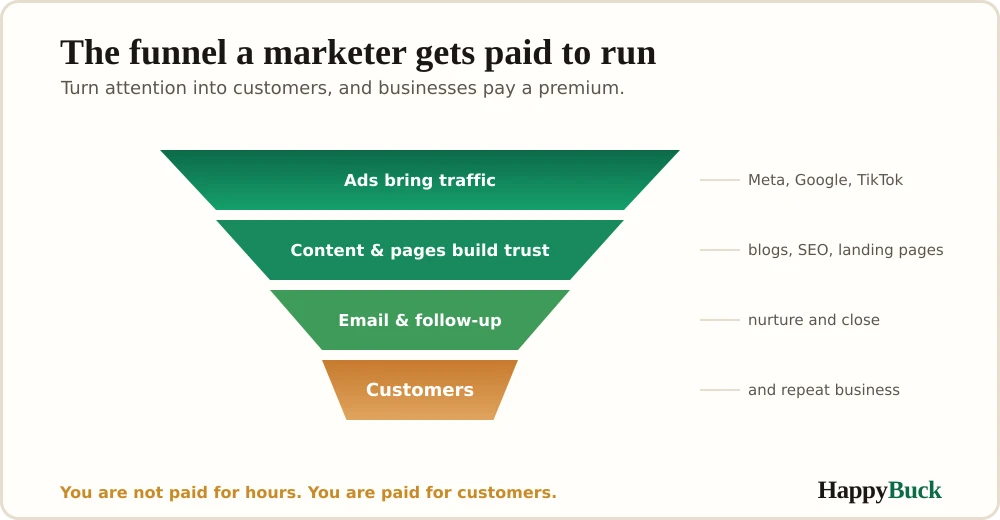
The two halves: paid and organic
You do not have to do everything. In fact, specializing is smarter. The field splits into two paths, and you can own one:
Paid (ads). Running campaigns on Meta, Google, YouTube, TikTok, and native platforms like Taboola. You control a budget and are judged on return: did the ad spend bring back more than it cost? This is the side I work on, and it is measurable to the dollar, which is exactly why clients value it.
Organic (content and SEO). Growing traffic without paying per click: keyword research, content strategy, and the long-term SEO work my wife specializes in. Slower to show results than ads, but it compounds and does not stop the moment you stop paying.
Pick the one that fits how you think. Both are in constant demand.
How to start with no clients
- Choose one specialty. Ads, SEO, content, email, or social. Depth beats breadth when you are unknown.
- Get a real result on something small. Run ads for your own project or a friend’s business. Grow a page. Rank an article. You need one measurable win.
- Turn that win into proof. “I ran this campaign and it returned X” is the most persuasive thing you can say. No certification competes with a result.
- Offer it to businesses that need customers. Local businesses and small brands often have no one doing this well. That gap is your opening. My own first marketing work came exactly this way. I was bartending, and the bar started paying me to run their social media and ads. I was self-taught and billed only a few hours at first, but it was a real client with a real result, and it came from a business that already knew me.
How to price it
Do not sell hours. Sell outcomes. Common structures:
- Monthly retainer for ongoing management, several hundred to several thousand per client depending on scope.
- Percentage of ad spend for paid campaigns, aligning your pay with the budget you manage.
- Project fees for defined work like an SEO audit or a campaign build.
Whatever you choose, anchor the price to the value of a customer to that business, not to your time. That single mindset shift is what separates marketers who scrape by from those who do very well.
The honest part: results or nothing
This field pays well because it is accountable. You cannot hide behind activity. Your ads either return money or they do not; your content either grows or it does not. That pressure is exactly why it pays, and why the people who are good at it are never short of work. Learn to move a real number and you will always be able to make money.
Where to go next
- Pair marketing with words that sell: how to become a freelance writer.
- New to client work entirely? How to start freelancing.
- Keep the income clean at tax time: side hustle taxes.
- The full guide to side hustles.
Digital marketing rewards skill and results over credentials and connections, which makes it one of the best side hustles to build. Learn to bring a business customers, prove it once, and price for the value you create. Do that and you have a skill that pays now and scales later. For free, unbiased fundamentals, Google’s Digital Garage and Meta’s own guides are solid places to learn the platforms.
Frequently asked questions
How do I start freelance digital marketing?
Pick one specialty you can deliver, paid ads, SEO, content, email, or social media, and get genuinely good at it on a small scale first. Run a campaign for your own project or a friend business to build a real result, then offer that specific service to businesses that need customers. Price on the value you create, since bringing a business paying customers is worth far more than an hourly wage.
How much can a freelance digital marketer make?
A lot, because you are tied directly to revenue. Freelancers often charge monthly retainers of several hundred to several thousand dollars per client for managing ads or content, plus some charge a percentage of ad spend. The ceiling is high because a marketer who reliably brings customers pays for themselves many times over, so businesses are willing to pay well.
Do I need certifications to run ads for clients?
No. Platform certifications like Google and Meta credentials can help you learn and look credible, but clients care about results, not badges. A real campaign you ran with a measurable outcome is far more persuasive than any certificate. Learn the platforms hands-on, prove you can move a number, and that proof is your qualification.
Is digital marketing a good side hustle in the age of AI?
Yes. AI is a tool marketers use, not a replacement for strategy and judgment. Someone still has to decide the offer, the audience, the message, and how to spend a budget wisely, and be accountable for the results. AI makes a skilled marketer faster and more valuable, while the pure button-pushing tasks are the ones getting automated.