
How to Budget Money: A Beginner’s Guide That Actually Sticks
A budget isn’t about restriction. It’s about telling your money where to go instead of wondering where it went. Here’s how to set one up and keep it.


To budget money, start with your monthly take-home pay and give every dollar a job before the month begins: cover your needs first, send something to savings and debt, then leave room for the fun stuff. A 50/30/20 split (50% to needs, 30% to wants, 20% to savings and debt) is a solid starting point. Track it for one month, then adjust.
That’s the whole thing. The rest of this guide is about making it stick, because a budget you abandon in week three isn’t a budget. It’s a guilt machine.
Here’s the honest part. Most budgets fail for the same reason crash diets do: they’re built for a perfect version of you who never orders takeout, never has a slow month, and never gets ambushed by a car repair. We’re going to build the other kind. The boring, flexible one you’ll still be using in March, July, and November.
What is a budget, really?
A budget is just a plan for the money you expect to earn and spend in a set period, usually a month. That’s it. It isn’t a punishment, and it isn’t a spreadsheet you have to love. It’s a decision you make once, on purpose, ahead of time, so you’re not making a hundred small money calls while you’re tired and standing in a checkout line.
The good ones answer three questions fast. What’s safe to spend? What needs to wait? Are my goals actually getting funded? If your budget can answer those, it’s working. If it can’t, it’s decoration.
How to budget money in 5 steps
You can set up your first budget in about an hour. Here’s the whole process.
- Find your real take-home pay. Not your salary. The number that actually lands in your account after taxes and deductions. If your income bounces around (freelance, tips, commission), use a conservative average of the last three months.
- List what you actually spent. Pull the last 30 to 60 days of transactions and group them into a few broad buckets: housing, food, transportation, debt, subscriptions, fun. Don’t judge the numbers yet. The first pass is just turning the lights on.
- Pick a framework. Most beginners do best starting with 50/30/20 (next section). It gives you guardrails without 40 categories to babysit.
- Give every dollar a job. Assign your income across your buckets until there’s nothing left unassigned, including savings and debt payoff, which are jobs too. Money without a job tends to wander off.
- Track and adjust. Check in once a week for five minutes. At month’s end, fix the numbers that were wrong. Your first budget is a rough draft, not a contract.
The goal isn’t a perfect month. It’s a budget that survives a normal one.
The 50/30/20 rule (and when to ignore it)
The simplest starting framework splits your take-home pay into three slices:
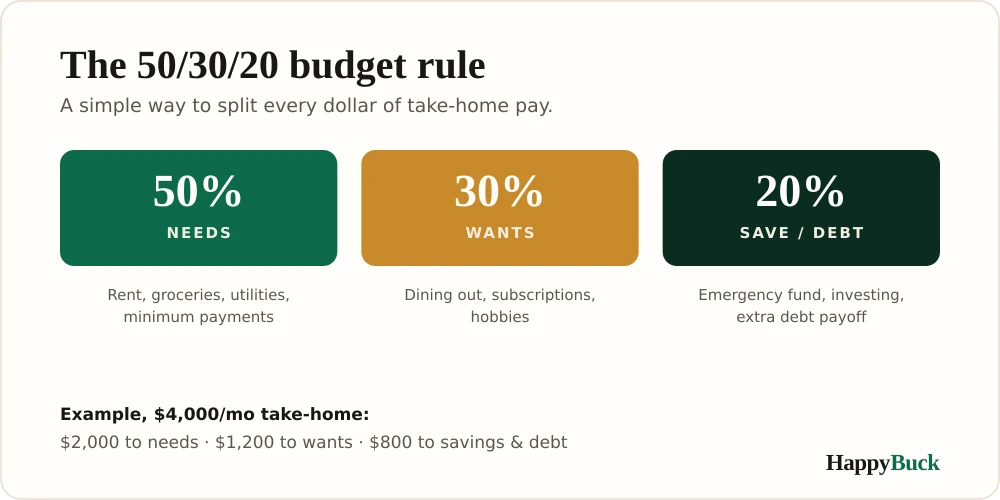
- 50% to needs. Rent or mortgage, groceries, utilities, transportation, insurance, and the minimum payments on your debts.
- 30% to wants. Dining out, streaming, hobbies, travel, the stuff that makes life worth budgeting for.
- 20% to savings and debt. Your emergency fund, retirement, and any extra you throw at debt beyond the minimums.
It works because it’s easy to remember and hard to overthink. But treat it as a starting line, not a law. If you live somewhere expensive, your needs might eat 60%, and that’s just reality. Shrink wants before you shrink savings. If you’re attacking high-interest debt, you might run a 50/20/30 version for a while and pour more at the balance. The percentages serve you, not the other way around.
How much should you spend on needs?
The common guidance is to keep your needs near 50% of take-home pay, with housing under about 30%. That’s the old “30% rule” for rent. It’s a useful gut check, not a hard limit. In a lot of cities, 30% is a fantasy, and plenty of people spend 35% to 40% on housing and make it work by trimming elsewhere.
What matters more than hitting a magic number is knowing yours. If housing plus the other true needs are crowding out any room to save, that’s the signal. The fix is usually bigger than budgeting, like a roommate, a move, or more income, not skipping lattes. For a deeper read on where your money realistically goes, the Bureau of Labor Statistics’ Consumer Expenditure Survey tracks what average households actually spend by category.
Other budgeting methods worth knowing
50/30/20 is the easiest on-ramp, but it isn’t the only road. As your money gets more complex, one of these might fit better:
| Method | How it works | Best for |
|---|---|---|
| Zero-based budget | Every dollar is assigned until income minus expenses equals zero | People who want maximum control and detail |
| Envelope system | Cash (or app “envelopes”) capped per category; when it’s empty, you’re done | Overspenders who need a hard stop |
| Pay-yourself-first | Automate savings and debt the day you’re paid, then spend the rest freely | Busy people who hate tracking |
There’s no trophy for picking the “advanced” one. The best method is the one you’ll keep doing. We’ll go deep on each of these in their own guides. For now, start simple and graduate later.
Spreadsheet or app: which budgeting tool should you use?
Three real options, in order of effort:
- A notebook or notes app. Genuinely fine to start. Friction is the enemy of a first budget, and nothing is lower-friction than a pen.
- A spreadsheet. Free, flexible, and yours forever. Excel or Google Sheets will do everything a beginner needs, and building one yourself teaches you exactly where your money goes. (Our step-by-step budget spreadsheet guide is coming next in this series.)
- A budgeting app. Apps automate the tracking by connecting to your accounts. Worth it if manual entry is the thing that makes you quit. Just know that convenience usually costs a subscription, and an app you ignore works exactly as well as no app at all.
Start with whatever you’ll actually open. You can always upgrade the tool once the habit is real.
Why most budgets fail (and how to keep yours)
Here’s the section nobody wants to write. Budgets fail, and usually for predictable reasons:
- They’re too tight. Zero room for fun is a budget designed to be broken. Build in a guilt-free category on purpose.
- They ignore irregular costs. Car registration, holidays, the annual insurance bill. These aren’t surprises. They happen every year. Set aside a little each month so they don’t blow up a good one.
- They’re built for an ideal month. Plan for the month that actually happens, with its bad days and its spontaneous plans, not the disciplined fantasy.
- They rely on willpower. Willpower runs out by Thursday. Automation doesn’t.
The fix for almost all of it is the same. Automate the important stuff, then leave yourself slack. Automate your savings and minimum debt payments for the day after payday, set calendar reminders for the rest, and stop trying to white-knuckle it. A budget that runs on autopilot survives the weeks you’re too busy to think about money, which is most of them.
Your first month: a simple example
Say you bring home $4,000 a month. A starting 50/30/20 budget looks like this:
- $2,000 to needs. Rent, groceries, utilities, transport, insurance, minimum debt payments.
- $1,200 to wants. Eating out, subscriptions, a concert, whatever you genuinely enjoy.
- $800 to savings and debt. Split between an emergency fund and extra payments on your highest-rate balance.
Run that for a month. Maybe needs come in at $2,300 and you have to pull $300 from wants. Fine, now you know. The number you learn beats the number you guessed. Adjust and run it again. By month three, it stops feeling like math and starts feeling like autopilot.
Where to go next
Budgeting is the foundation, but it’s connected to everything else. Once your plan is running, the highest-leverage next moves usually are these:
- Build a starter emergency fund so a surprise doesn’t become debt.
- If you’re carrying balances, get a real plan to pay down high-interest debt.
- Want more margin in the budget? The fastest lever is often the income side, like a side hustle that fits your life.
You don’t need a perfect system. You need a simple one you’ll keep using. Pick a framework, give every dollar a job, and check in once a week. That’s a budget that sticks, and it’s the quiet engine behind every other money goal you’ve got.
Want the official worksheets? The Consumer Financial Protection Bureau and the Federal Reserve’s research on household financial well-being are solid, no-hype places to go deeper.


