How to Become a Freelance Writer (From a 10-Year Copywriter)
Freelance writing can pay a little or a lot, and the difference is what you write and who you write it for. Here is how to become a writer who gets paid well, from a decade in the trade.


To become a freelance writer who actually gets paid well, pick a type of writing that businesses buy, learn to do it genuinely well, prove it with a couple of strong samples, and land your first clients through people who need that specific thing. Then raise your rate as your results pile up. The part most guides miss is that your income depends far less on talent than on what you choose to write and who you write it for. I have spent about a decade doing this, and that one choice is the whole ballgame.
I write in the finance space, long-form promotions, sales pages, email sequences, ad copy, and scripts for video sales letters, with a focus on full-funnel marketing. That specialization is not a flex, it is the point: it is why the work pays what it does. Let me show you how to get there.
The choice that sets your income: what you write
Not all writing pays the same, and it is not close. This is the single most important thing to understand before you start.
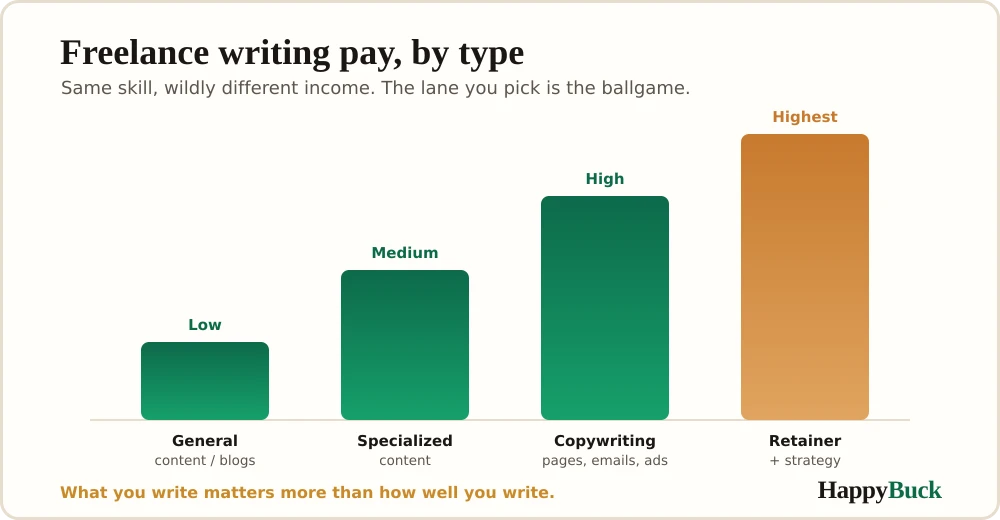
| Type of writing | What it is | Typical pay |
|---|---|---|
| General content / blogs | Informational articles, SEO posts | Low: cents per word to ~$150/post |
| Specialized content | Expert or technical articles, whitepapers | Medium: $150 to $800+/piece |
| Copywriting | Sales pages, emails, ads, VSLs | High: hundreds to thousands per project |
| Retainer / strategy | Ongoing copy plus marketing strategy | Highest: monthly retainers |
The writers struggling to make rent are almost always stuck writing commodity content for pennies. The writers doing well have specialized in writing that is tied directly to a client making money. That is the move.
Step 1: Pick a niche and a type
“Writer” is too broad to hire. “Finance copywriter” or “SaaS email specialist” is a person a business can picture paying. Combine a subject you understand with a type of writing that pays:
- A niche you know or can learn: finance, health, tech, real estate, e-commerce.
- A type that businesses pay for: copywriting, email, content, or scripts.
I write finance copy because I understand the subject and the money follows the specialization. Yours can be different, but pick a lane. Generalists compete on price; specialists compete on results.
Step 2: Learn the craft that gets paid
Good copy is not decoration, it is persuasion built on structure. Learn how the writing that sells works: how to lead with the reader’s problem, hold attention, and drive one clear action. Study real sales pages and emails, not just style guides. If you want to write copy that manages the whole funnel, understand how the pieces connect, from the ad that gets the click to the email that closes.
Step 3: Build proof, even self-assigned
You do not need clips from famous brands. You need samples that show you can write the thing you are selling. Write a mock sales page for a product you like. Draft an email sequence for a real business. Rewrite a weak ad and explain why yours is better. Self-assigned work counts when it proves the skill.
Step 4: Land your first clients
Same engine as any freelance business: start with people who know you, show your proof, and ask for the work and for referrals. Businesses everywhere need words that sell, and most owners cannot write them. That gap is your opportunity.
Step 5: Raise your rate as results come in
Early on, charge to win the work. But the moment your writing produces a result, an email that got opens, a page that converted, a post that ranked, your value changes, and your price should too. Get in the habit of asking clients for the outcome your work drove, because results, not word counts, are what let you charge real money.
A note on AI, since everyone asks
AI can generate endless generic text, which means generic text is worth less than ever. That is bad news only if generic text was your product. The writing that still pays, and pays more now, is the writing AI cannot do well: real strategy, a distinct voice, original stories, genuine audience insight, and accountability for whether it works. Bring those, and you are more valuable in this market, not less.
Related reads
- Not sure freelancing is your lane yet? Start with how to start freelancing.
- Pair writing with ad skills: freelance digital marketing.
- Handle the income right: side hustle taxes.
- The full guide to side hustles.
Freelance writing is one of the most accessible skills to monetize and one of the easiest to underprice. Choose writing that businesses pay well for, get genuinely good at it, prove your results, and charge for the value you create. Do that and it can go from a side gig to a career, the way it did for me. For a broad look at writing as a profession, the Bureau of Labor Statistics has honest data on the field.
Frequently asked questions
How do I become a freelance writer with no experience?
Choose a type of writing businesses pay for, such as copywriting, content, or email, write one or two strong samples in that style, and start offering the service to people and companies who need it. You do not need a degree or clips from big publications. You need proof you can write the specific thing a client wants to buy, plus the persistence to land the first few gigs.
How much do freelance writers make?
It ranges enormously. General content writing might pay a few cents a word or 50 to 150 dollars per article, while specialized copywriting, sales pages, email funnels, and ads, can pay hundreds to thousands per project once you are experienced. The single biggest factor in your income is not talent, it is what you write and for whom. Direct-response and sales copy pay far more than generic blog posts.
What is the difference between a copywriter and a content writer?
A copywriter writes to drive a specific action, sales pages, ads, emails, and video scripts designed to get someone to buy or click. A content writer writes to inform or attract, blog posts, guides, and articles that build trust and traffic. Copywriting is usually tied more directly to revenue, which is why it tends to pay more, but strong content writing is in high demand too.
Is freelance writing still worth it with AI around?
Yes, but the bar has moved. AI can produce generic filler, so the writing that pays is the writing AI does not do well: work that requires real strategy, a genuine voice, original stories, deep audience understanding, and accountability for results. Writers who bring judgment and expertise are more valuable now, not less. Writers who only produced commodity text are the ones feeling the squeeze.