
How to Get Out of Debt: A Real Plan That Works
Getting out of debt is not about willpower or a magic program. It is a plan: list what you owe, pick a payoff method that keeps you going, and avoid the "help" that makes it worse.


To get out of debt, the plan is simpler than the industry wants you to believe: list every debt you owe, free up as much money as you can in your budget, then throw that money at one debt at a time using either the snowball or the avalanche method while paying minimums on the rest. Keep it up, stop adding new debt, and be careful about who you take “help” from. That is the whole thing. No secret program, no debt-relief company required.
Here is the honest part up front. The debt world is full of companies that profit from your stress, promising to make it all disappear for a fee. Most people do not need them, and some of that “help” leaves you worse off. What actually works is a plan, a little math, and the persistence to stick with it. This guide walks through exactly that.
I take debt seriously because I watched it up close. My mom raised my sister and me on a teacher’s salary. Teaching is one of the most important jobs there is, and it has never paid like it. What I did not know until I was older was that for years she was quietly carrying serious debt. She shielded us from the stress and worked incredibly hard to dig out, but money was genuinely tight until my sister and I were around twelve or thirteen. When she finally told me about it in high school, it stuck with me. It scared me off credit cards for years, honestly longer than it needed to, since I leaned on a debit card well into my mid-twenties. But it taught me the two things this whole guide keeps coming back to: debt can quietly take over a life, and with a real plan and enough persistence, you can beat it. My mom did.
Step 1: List every debt
You cannot make a plan against a number you are avoiding. Pull it all into one place, on paper or in a spreadsheet, and write down four things for each debt: who you owe, the balance, the interest rate, and the minimum payment.
| Debt | Balance | Interest rate | Minimum |
|---|---|---|---|
| Store card | $600 | 27% | $25 |
| Credit card | $4,200 | 22% | $110 |
| Car loan | $9,000 | 7% | $260 |
| Student loan | $14,000 | 5% | $150 |
Seeing it all in one place is uncomfortable, and it is also the moment the problem stops being a vague dread and becomes something you can actually attack.
Step 2: Free up money to attack it
Extra debt payments have to come from somewhere. That means a budget, so you can find the gap between what you earn and what you spend, and point it at your debt. Two quick wins usually surface the fastest money: canceling subscriptions and negotiating your bills, and trimming the big flexible categories.
One important exception first: keep a small starter emergency fund of around $1,000 before you go all-in on debt. Without any cushion, the next surprise goes right back onto a credit card and undoes your progress. Small buffer first, then attack.
Step 3: Pick a payoff method (snowball or avalanche)
This is the core decision, and there are two proven methods. You pay the minimum on everything, then send every extra dollar at one target debt until it is gone, then roll that payment to the next.
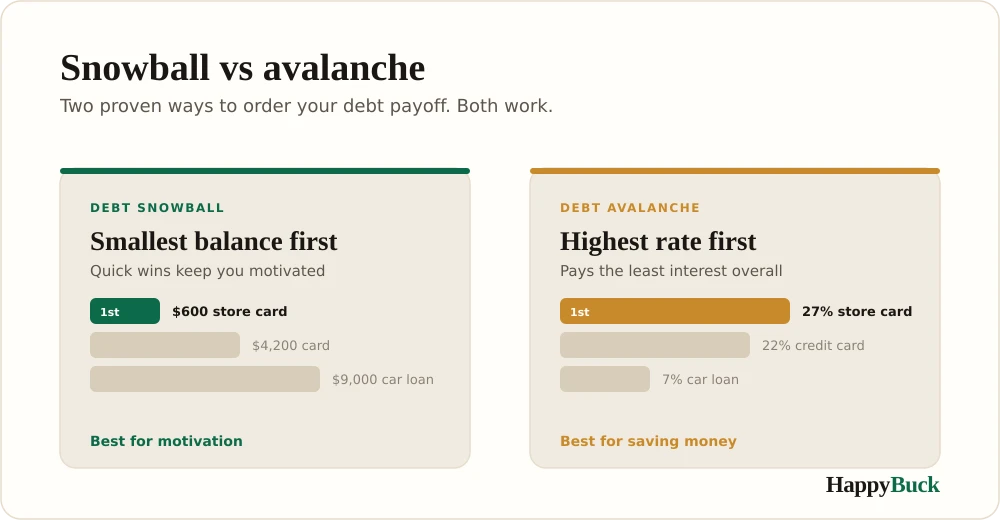
| Method | Pay off first | Best for | The tradeoff |
|---|---|---|---|
| Debt snowball | Smallest balance | Motivation and quick wins | Costs a little more interest |
| Debt avalanche | Highest interest rate | Saving the most money | The first win takes longer |
The avalanche is mathematically optimal: attack the highest rate first and you pay the least interest overall. The snowball attacks the smallest balance first, so you knock out a whole debt fast and get a motivating win early, which is why people stick with it even though it costs slightly more.
Here is the honest answer on which to pick: the best method is the one you will actually finish. If you are motivated by numbers and want to save the most, run the avalanche. If you need to feel progress to keep going, run the snowball. Both work. We break down the full comparison in our guide to the debt snowball vs the debt avalanche.
Step 4: Stop adding new debt
You cannot dig out while you keep digging in. This is the unglamorous half of every debt story. Pause the credit cards, skip the buy-now-pay-later at checkout, and let your starter emergency fund, not a card, absorb the small surprises. Getting out of debt is two moves at once: paying down the old, and not creating the new.
Step 5: Be careful who you take “help” from
Not all debt help is equal, and the difference matters:
- Nonprofit credit counseling is legit. Agencies affiliated with the National Foundation for Credit Counseling offer free or low-cost advice and can set up a debt management plan. A good starting point if you feel stuck.
- Balance transfers and consolidation are tools, not magic. Moving high-rate balances to a lower rate can genuinely help, but only if you stop spending and actually pay it down. We cover the real math on balance transfer cards and debt consolidation.
- For-profit debt settlement is the risky one. Companies that promise to settle your debt for pennies often tell you to stop paying, charge big fees, and can tank your credit for years. Understand exactly what you are signing up for, and treat “make your debt disappear” ads with deep skepticism.
How long does it take?
Longer than a fad, shorter than it feels. Many people clear their consumer debt (everything but the house) in roughly 18 to 24 months of focused effort, though it depends entirely on how much you owe and how much you can put toward it. The timeline matters less than the direction. Once the balances start falling instead of climbing, the momentum carries you.
Where to go next
- The core decision, in depth: debt snowball vs debt avalanche.
- Tackling cards specifically? How to pay off credit card debt.
- Lower the rate the right way: balance transfer cards and debt consolidation.
- Know which debt is even worth keeping: good debt vs bad debt.
- Specific debts: how to pay off student loans and paying off debt on a low income.
- Not sure whether to save or pay off debt first? Here is the order.
- The money to pay debt comes from a budget, and sometimes from earning more.
Getting out of debt is not a personality test or a willpower contest. It is a plan you run: list what you owe, free up money, attack one debt at a time, and stop the bleeding. Do that consistently and the math works in your favor for once. For free, unbiased help, the FTC’s guide to getting out of debt and nonprofit credit counseling are honest places to start.


