
How to Save Money: A Realistic Guide (Cut the Big Costs First)
Saving money is not about deprivation. It is about cutting the big recurring costs, automating the rest, and letting the savings happen without white-knuckling every purchase.


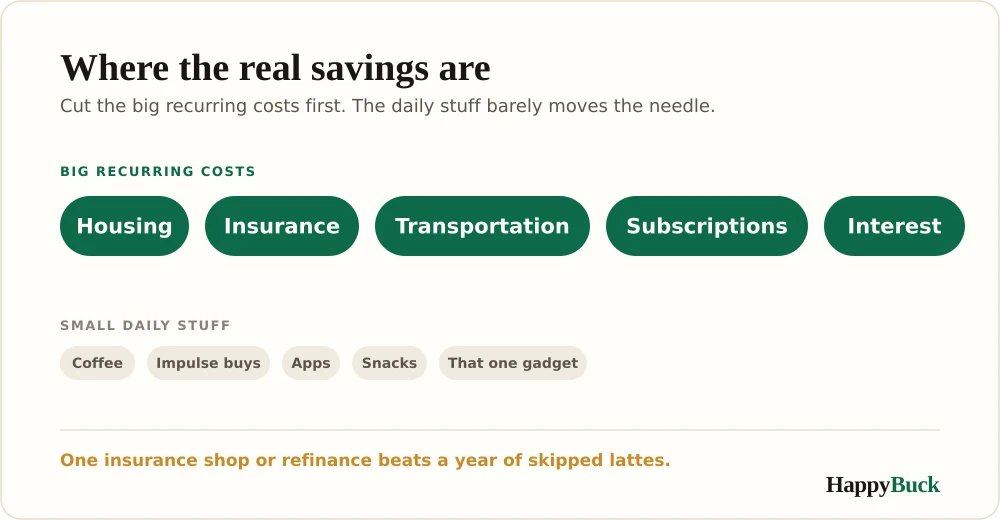
The best way to save money is to attack your biggest recurring costs first, automate your savings so it happens before you can spend it, and trim the everyday expenses that do not actually matter to you. Skipping small treats gets all the headlines, but the real money hides in the big stuff: housing, insurance, transportation, subscriptions, and interest. Fix a couple of those once and you save more than a year of skipped lattes.
Here is the honest part that most “50 ways to save money” lists will not tell you: cutting tiny daily expenses feels productive but barely moves the needle. Saving money that actually adds up is less about discipline and more about a few smart decisions you make once and then automate. This guide is about those decisions.
First, know where your money actually goes
You cannot cut what you cannot see. Before you trim anything, spend one month watching where your money really goes. Almost everyone finds a leak they did not know about, usually subscriptions or takeout. Our guide to tracking your spending walks through the fastest way to do it without turning it into a second job.
The first time I did this, I found over $100 a month going to subscriptions I had forgotten I was paying for. I did not budget harder. I just turned the lights on and canceled what I was not using.
Save on the big rocks first
This is the part that matters most, and the part the listicles bury under “brew coffee at home.” Picture filling a jar: you put the big rocks in first. Your biggest savings live in your biggest, most repeated costs, so handle those before you fuss over the pebbles.
| Lever | Why it moves the needle | Effort |
|---|---|---|
| Housing | Your single biggest line item. A roommate, a move, or a refinance dwarfs any daily cut | High |
| Insurance | Shopping car and home coverage every year or two often saves hundreds | Low |
| Subscriptions | Easy to forget and quietly renewing. Auditing them frees cash immediately | Low |
| Food | Groceries and takeout are large and flexible, with real room to trim | Medium |
| Interest | High-rate debt drains money every single month before you spend a cent | Medium |
Notice what is not on that list: your morning coffee. One insurance shop or one canceled subscription bundle can beat a year of skipped $5 lattes, without making your day worse. Start where the money is.
Keep your non-negotiables
Here is something I genuinely believe: you are allowed to keep the small things that make you happy. We all know making coffee at home is cheaper than a run to Starbucks or Dunks. But we work hard for our money, and part of the whole point of earning it is getting to enjoy the little things. I could save a couple of bucks skipping the coffee shop, but I like going, and that small happiness in a cup is worth it to me. When you start saving, it is completely fine to have a few non-negotiables you refuse to give up.
That is not an excuse to ignore your budget. It is the opposite. Once you start documenting where your money actually goes, the stuff you can genuinely give up becomes obvious, and it is almost never the $5 coffee. It is the subscriptions you forgot about, the insurance you never reshopped, the things you would not even miss. Cut those, keep your coffee, and you still come out ahead, without feeling deprived.
Automate it so you do not have to think
Willpower runs out by Thursday. Automation does not. The single most reliable way to save is to move the money before you can spend it, which is the whole idea behind paying yourself first: set up an automatic transfer to savings for the day you get paid. If the money never lands in your checking account, you never miss it, and saving stops depending on how disciplined you feel that week.
Build your emergency fund
The first real destination for that automated savings is an emergency fund, a cash cushion that keeps a surprise from becoming debt. Start small. A $500 to $1,000 starter fund is enough to break the paycheck-to-paycheck cycle, then build toward three to six months of expenses over time. Keep it somewhere separate and earning interest, like a high-yield savings account. Our full guide to how much emergency fund you need and how to build it walks through the whole thing.
For the predictable-but-irregular costs that are not emergencies (car registration, the holidays, an annual premium), a sinking fund is the companion habit. Emergency fund for surprises, sinking funds for the stuff you can see coming.
Save on the everyday, without feeling deprived
Once the big rocks are handled, the daily stuff is worth trimming too, as long as it does not make your life smaller. The goal is deliberate, not punishing:
- Lower your recurring bills. Negotiating internet, phone, and insurance, and canceling forgotten subscriptions, is the fastest money there is.
- Save on groceries, one of the most flexible big categories, by planning meals and wasting less.
- Put a 24-hour rule on impulse buys. Most wants fade overnight. The ones that do not are the ones worth buying.
- Try a savings challenge if you need momentum, then automate what worked.
The honest part
Saving money has a hard limit, and it is worth being honest about it. You can only cut so far. If your essentials genuinely do not fit your income, no amount of frugality closes that gap, and the real fix is on the earning side, whether that is a raise, more hours, or a side hustle. Frugality and income are two different levers, and past a point, income is the one that matters. Do not let anyone shame you into thinking a tighter grocery budget fixes an income problem.
Where to go next
- Build the cushion first: how much emergency fund you need.
- Keep your cash somewhere it earns: high-yield savings accounts.
- Wondering if you are on track? How much you should have saved by age.
- New here? Start with the budgeting basics, or automate saving with pay yourself first.
- On a tight budget? How to save money on a low income. Want a bigger gap to save from? Look at side hustles.
Saving money is not about becoming the kind of person who never enjoys anything. It is about cutting the big recurring costs, automating the rest, and being deliberate with what is left. Do that, and the savings pile up quietly in the background while you get on with your life. For free, no-hype tools, the Consumer Financial Protection Bureau has solid savings resources.


