Side Hustle Taxes: How Much to Set Aside (1099 Reality)
The part every side-hustle guide skips: nobody withholds taxes from your gig income, and the bill is bigger than you think. Here is exactly how much to set aside so tax season is not a disaster.


Here is the thing almost every side-hustle article leaves out, and it is the one that bites people hardest: nobody withholds taxes from your side income, and you owe more tax on it than you probably expect. A safe move is to set aside 25 to 35 percent of your profit from day one, in a separate account, so that when the bill comes it is already handled. Do that and taxes become a non-event. Skip it and tax season can wipe out months of earnings you already spent.
I am not a tax professional, and this is general information, not tax advice, so check specifics with a pro or the IRS for your situation. But after years of 1099 income, this is the part I wish someone had drilled into me early, because it is simple once you know the rules.
Why the tax bill is bigger than you think
Side hustle income gets hit by two taxes, not one:
- Income tax, at your normal rate, just like a regular paycheck.
- Self-employment tax of 15.3 percent, which covers Social Security and Medicare.
That second one is the surprise. At a normal job, your employer quietly pays half of that 15.3 percent for you. When you work for yourself, you pay both halves. So the same dollar earned on the side is taxed more heavily than a dollar from a W-2 job, before your income tax even applies.
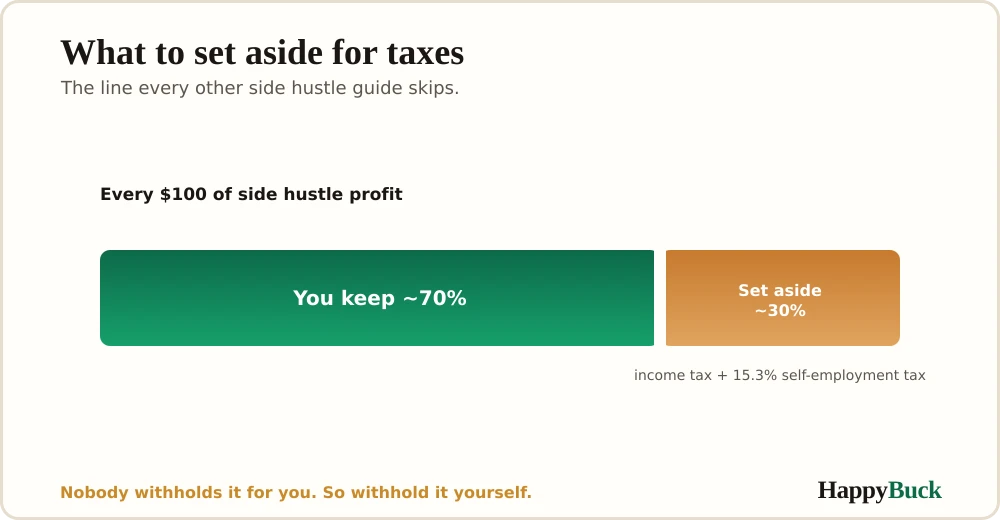
The rule: set aside 25 to 35 percent of profit
The safe habit is to skim a quarter to a third off every payment and park it in a separate savings account you do not touch:
| Your situation | Set aside |
|---|---|
| Lower income / low tax bracket | ~25% of profit |
| Most people | ~30% of profit |
| Higher earners / higher-tax state | ~35% of profit |
Note it is a share of profit, meaning income minus your business expenses, not every dollar that comes in. If you are unsure, 30 percent in a separate account is a sane default. Anything left over after taxes is a bonus, which is a much better surprise than a shortfall.
Cash counts too
This trips people up: income is taxable even when it is cash and no form ever shows up. A client paying you under the table, a service hustle paid in cash, a gig that never sends a 1099, all of it is legally reportable income. Not getting a tax form does not make it tax-free. It just means the record-keeping is your job.
Pay quarterly, not all at once
If you will owe roughly $1,000 or more for the year, the IRS generally expects estimated tax payments four times a year instead of one big payment in April. Paying quarterly keeps you from a giant bill and avoids underpayment penalties. Since you are already setting the money aside as you earn it, sending it in on the quarterly dates is easy. The due dates are roughly mid-April, mid-June, mid-September, and mid-January.
Lower the bill: track your expenses
Because you are taxed on profit, legitimate business expenses reduce what you owe. Keep simple records of what you spend to do the work:
- Tools, software, and equipment
- Supplies and materials
- Mileage and vehicle costs for the business
- A home office, if you qualify
- Fees, subscriptions, and platform cuts
You do not need fancy software, just a consistent record and saved receipts. Every real expense you track is income you are not taxed on.
Where to go next
- Fund the tax account without feeling it: how to save money.
- Keep the whole operation organized with a simple budget.
- See realistic earnings before taxes: how much a side hustle can make.
- The full guide to side hustles.
Taxes are the least fun part of a side hustle and the easiest to get blindsided by. Set aside a quarter to a third of your profit from the first dollar, keep it separate, track your expenses, and pay quarterly if you owe enough. Handle it that way and the tax bill is just a line item, not a crisis. For the official rules, the IRS gig economy tax center and self-employed center are the authoritative sources.
Frequently asked questions
How much should I set aside for side hustle taxes?
A safe rule is to set aside 25 to 35 percent of your side hustle profit (income minus expenses). That covers federal income tax plus the 15.3 percent self-employment tax, and often state tax too. If you are in a low bracket, the lower end may be enough; higher earners should lean toward the top of that range. When in doubt, save 30 percent in a separate account and adjust from there.
Do I have to pay taxes on side hustle income?
Yes. All income from a side hustle is taxable, even if a client pays you in cash and never sends a 1099 form. You are legally required to report it and pay income tax plus self-employment tax on your profit. Not receiving a tax form does not make the income tax-free, it just means the reporting is on you.
What is self-employment tax and why do I owe it?
Self-employment tax is the 15.3 percent that covers Social Security and Medicare. When you have a regular job, your employer pays half of this and you pay half. When you work for yourself, you pay both halves, which is why side hustle income is taxed more heavily than many people expect. It applies on top of regular income tax.
Do I need to pay quarterly estimated taxes on a side hustle?
If you expect to owe about 1,000 dollars or more in tax for the year from self-employment, the IRS generally wants you to pay estimated taxes four times a year rather than all at once in April. Paying quarterly avoids underpayment penalties and keeps the bill manageable. Set the money aside as you earn it and send it in on the quarterly due dates.