How to Start Freelancing (With No Experience)
You do not need a portfolio or permission to start freelancing. You need one skill and one paying client. Here is exactly how to get both, from someone whose freelance gig became a career.

To start freelancing with no experience, pick one skill you can already do, prove it with a small sample, and tell the people who already know you that you are open for work. Your first client comes from that warm network far more often than from a job board. Charge a little under your target rate to win the first gig, do excellent work, then use that result to raise your price and land the next one. That is the whole path, and there is no gatekeeper who has to let you in.
Freelancing feels like it needs a portfolio, a website, and permission. It needs none of those. It needs one skill and one person willing to pay for it.
I started freelancing before I had any “credentials”
When I began freelancing as a copywriter, I had no formal proof I could do it. My income at the time came from landscaping and home renovation work. But I could write, and I knew a few people who needed writing done, so I offered. The first jobs were small and underpaid. They were also everything, because each one gave me a result I could point to for the next client. A decade later, that side gig is my career.
The lesson I would give my younger self: you do not need to feel ready. You need one person to say yes, and then you need to do a great job for them.
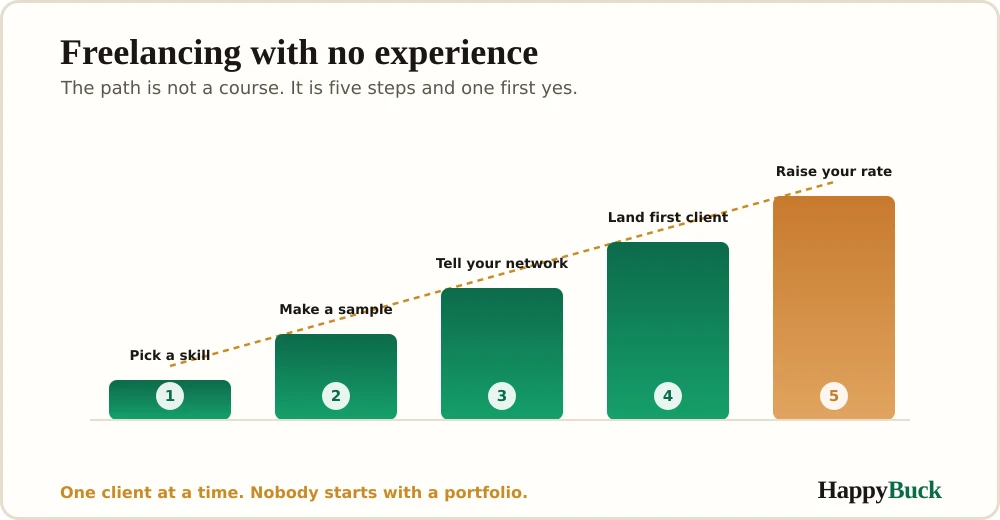
Step 1: Pick a skill you can already sell
You are not looking for the perfect skill. You are looking for one you can do at a useful level right now, that a business will pay for:
- Writing, editing, or copywriting
- Design, video editing, or photography
- Web development or tech setup
- Marketing, ads, and social media
- Bookkeeping, admin, or virtual assistance
- Tutoring or coaching in something you know
If someone would pay to have it done, it is a freelance service. Pick the one where you can start earning fastest.
Step 2: Make one piece of proof
You do not need a full portfolio. You need one sample that shows you can do the work. A single writing piece, one mock design, one real project even if the first one is for a friend at a discount. Proof turns “trust me” into “look at this,” and that is what gets you hired.
Step 3: Tell the people who already know you
This is the step people skip because it feels less official than setting up a profile. It is also where almost every first client comes from. The people who already trust you are far more likely to hire you or refer you than a stranger on a bidding site.
- Say plainly what you now offer.
- Ask if they, or anyone they know, needs it.
- Make it easy to say yes with a clear, simple offer.
Freelance platforms like Upwork and Fiverr can supplement this, but they are crowded and push prices down. Warm introductions are your fastest, highest-quality path early on.
Step 4: Price to win the first client, then climb
Your first client is partly paying a discount for betting on someone unproven. That is fair. So start a little under your target rate to lower the risk of hiring you, then raise it quickly as results stack up. What you do not do is compete on being cheapest. Cheap work attracts clients who treat you badly and pay you little. Price for the value of the result, and once you can prove that result, charge accordingly.
Step 5: Deliver like your next three gigs depend on it
Because they do. Referrals and repeat work are the entire freelance engine. One client you impress becomes a review, a referral, and a rehire. Hit your deadlines, communicate clearly, and make the person glad they took a chance on you. That reputation compounds faster than any marketing.
What to read next
- If writing is your skill: how to become a freelance writer.
- Prefer selling effort over a skill? Service side hustles that pay cash.
- Handle the money right: side hustle taxes and what to set aside.
- The full guide to starting a side hustle.
Freelancing is not reserved for people with the perfect resume. It is open to anyone with one real skill and the nerve to offer it. Start with what you can do, get one client, do great work, and let it build. For the official basics on operating as a self-employed freelancer, the IRS self-employed center covers what you need to know.
Frequently asked questions
How do I start freelancing with no experience?
Pick one skill you can already do at a useful level, create one or two samples to prove it, then tell everyone who already knows you that you are open for work. Your first client almost always comes from your existing network, not a job board. Price your first gig slightly low to win the chance, deliver great work, then use that result to raise your rate and find the next client.
What skills are best for freelancing?
Anything a business will pay to have done: writing, design, web development, marketing and ads, bookkeeping, video editing, photography, tutoring, or virtual assistance. The best skill for you is the one you can already do reasonably well, because you can start earning now instead of spending months learning from zero.
How do freelancers get their first client?
Usually through people who already know and trust them. Tell your network exactly what you offer, show one piece of proof, and ask for referrals. Freelance platforms like Upwork can work too, but they are crowded and price-competitive. A warm introduction beats a cold bid almost every time when you are starting out.
How much should I charge when I start freelancing?
Start slightly below your target rate to win your first few clients, since they are taking a chance on someone unproven, then raise your rate quickly once you have results to show. Do not race to the bottom. Cheap work attracts difficult clients and burns you out. Price for the value of the result, not your nerves.