Side Hustles: How to Start One That Actually Makes Money
The best side hustle is not some app you saw in an ad. It is a skill or effort you already have, sold to someone who needs it. Here is how to start one that actually makes money.


A side hustle that actually makes money almost never comes from a “make money online” ad. It comes from something much less exciting: a skill or an effort you already have, sold to someone who needs it. Start there, land your first paying client, price the work so it is worth your time, keep some of the money aside for taxes, and stay away from anything that asks you to pay upfront to “unlock” earnings. That is the whole playbook, and it works because it is built on real value instead of a pitch.
My wife and I have run side hustles our entire adult lives, and we still do. We have always believed in having more than one way to make money, both to build toward the future and because a single income is a fragile thing. What I have learned from all of it is simple: the side hustles that pay are the boring, honest ones, and the ones that promise easy money are almost always selling you the dream, not the income.
I know this because my career started as a side hustle
I am a copywriter. For about a decade I have written in the finance world, long-form promotions, sales presentations, email and ad copy, even scripts for video sales letters, specializing in full-funnel marketing. But when I started out, copywriting was not my job. It was my side hustle. My actual income back then came from landscaping and home renovation work for people around me. I wrote copy at night and on weekends, took small gigs, got better, and slowly the side thing became the main thing.
My wife did the same in reverse. Today she does organic content and SEO for B2B companies, a lot of it in manufacturing, building content maps and doing deep keyword research. But when she was starting out, she worked at an animal shelter and trained dogs to make them more adoptable. Two very different beginnings, same lesson: you start with what you can actually do, you get paid for it, and you build from there.
That is the honest version of side hustles, and it is the one this guide is built on.
Step 1: Start with what you already have
Every real side hustle comes from one of two things you already own:
- A skill you can sell. Writing, design, coding, marketing, bookkeeping, photography, tutoring, editing. If someone would pay for it, it is a freelance business waiting to start.
- Time and effort you can sell. Landscaping, cleaning, handyman work, pet care, delivery, moving help. Less glamorous, often paid in cash, and genuinely reliable. These service side hustles are how a lot of us, me included, got our start.
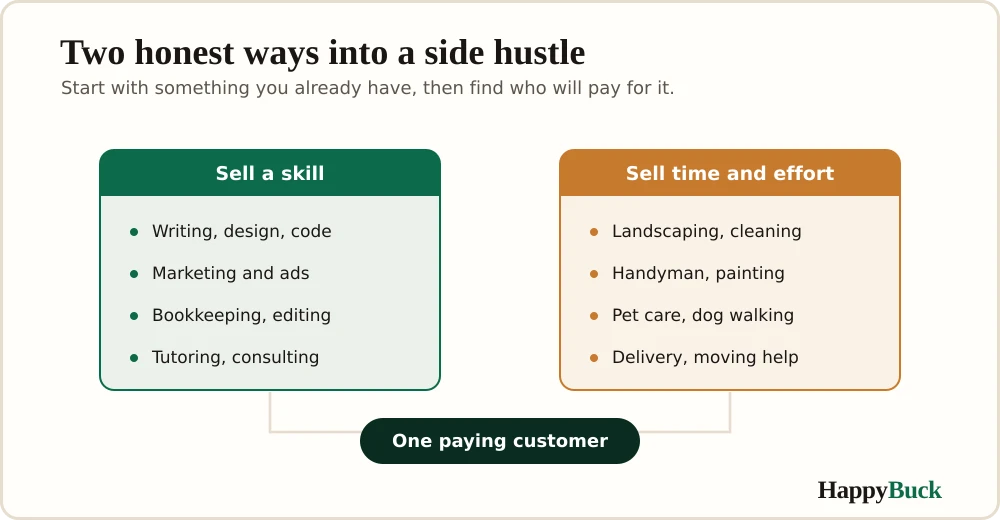
You do not need a new idea. You need to look at what you can already do and find the person who will pay for it.
Step 2: Get your first paying customer
This is the hard part, and it is where most side hustles die before they start. Nobody’s first client comes from a course. Mine came from people who already knew I could write. Here is what actually works:
- Tell the people who know you. Your first gigs come from your existing network far more often than from strangers. Say what you are offering, out loud, to people who already trust you.
- Show proof, even small. One writing sample, one before-and-after photo of a yard, one happy customer’s word. Proof beats promises.
- Start slightly cheaper, then raise fast. Your first client is partly buying a discount for taking a chance on you. Once you have results to point to, your rate goes up.
Step 3: Treat it like a business, not a hobby
The people who make real money on the side are the ones who run it like it matters:
- Price for your time, not your insecurity. Cheap work attracts bad clients and burns you out. Charge what the result is worth.
- Keep the money separate and pay your taxes. Side income is usually 1099 income, and no one withholds taxes for you. Set a share aside from day one so tax season is not a disaster. Here is exactly how much to hold back.
- Deliver like your reputation depends on it, because it does. Referrals and repeat clients are the whole game. One great job creates the next three.
Step 4: Know which hustles are real and which are bait
The side-hustle world is full of pitches designed to sell you a dream. I know the machinery because I spent a decade building marketing funnels, so I can tell you plainly: if something requires you to pay upfront to “unlock” income, promises passive money with no skill or work, or hides what you actually do to earn, it is selling you, not paying you.
- Sort the real from the noise: the best side hustles, ranked honestly.
- Understand what is actually true about passive income.
- Set realistic expectations for how much a side hustle can actually make.
Step 5: Decide if it becomes something bigger
Some side hustles stay a nice extra few hundred a month, and that is a perfectly good outcome. Others, if you keep showing up and getting better, quietly turn into a career. Mine did. If yours starts pulling real weight, here is how to turn a side hustle into a full-time income without leaping before it is ready.
Where to start
Pick the path that matches what you already have:
- Have a skill? How to start freelancing and, if writing is your thing, how to become a freelance writer.
- Rather sell effort? Service side hustles that pay cash.
- Good with ads and marketing? Freelance digital marketing.
- Want the honest landscape first? The best side hustles, ranked and how much they really make.
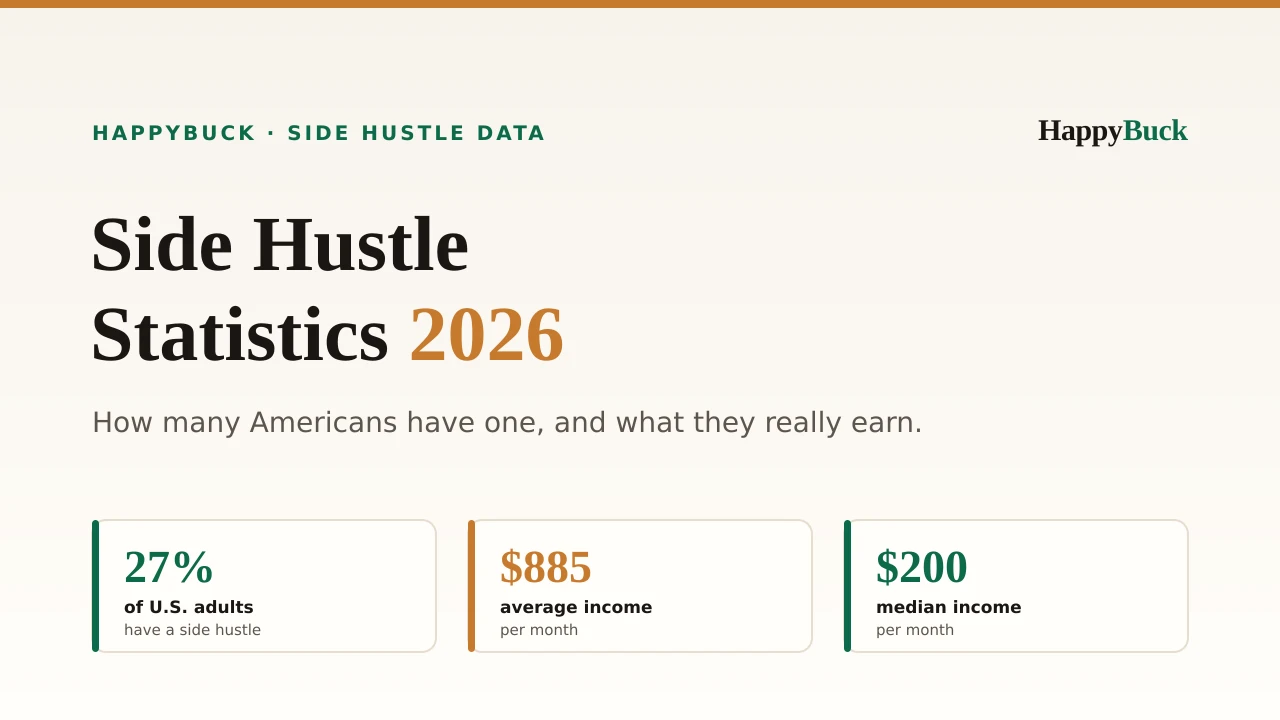
- Curious how common they are and what people earn? See the latest side hustle statistics.
A side hustle is not a lottery ticket. It is a small business you build out of something you already have, one paying customer at a time. Do that, treat the money seriously, and it can become an emergency fund, a debt payoff, or in my case a whole career. For the tax and legal basics of running one, the IRS gig economy tax center is the official, no-hype place to start.