How Much Can a Side Hustle Actually Make? (Real Numbers)
Forget the "$10k a month in your sleep" screenshots. Here are honest, realistic numbers for what different side hustles actually pay, and what separates a $200 month from a $2,000 one.


Here is the honest answer nobody selling a course will give you: most side hustles make a few hundred to a couple thousand dollars a month, and what determines where you land is your skill, your hours, and what you are selling, not some trick. The “$10,000 a month in your sleep” screenshots are marketing, showing the rare top performer to sell you the dream. The real range is more modest and, frankly, more useful, because a realistic extra $500 to $2,000 a month genuinely changes a budget.
Let me set honest expectations, because knowing the real numbers is what lets you pick the right hustle and stick with it instead of quitting when you do not hit a fantasy in month one. The national data agrees: the average side hustle earns about $885 a month, but the median is just $200 (see the full side hustle statistics).
The realistic ranges
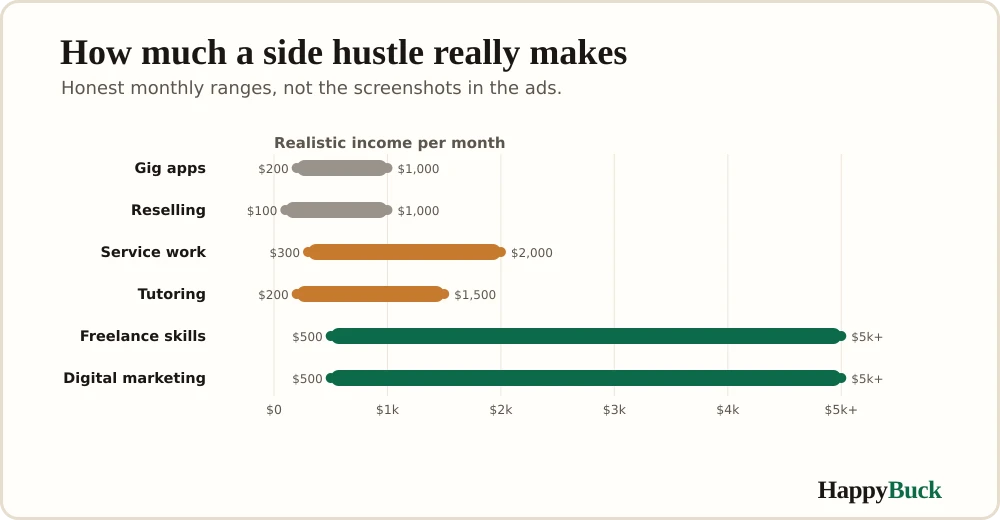
| Side hustle type | Realistic monthly range | What moves you up the range |
|---|---|---|
| Gig apps (delivery, rideshare) | $200 to $1,000 | More hours; better local demand |
| Service work | $300 to $2,000+ | Repeat clients; a skill; raising rates |
| Reselling / flipping | $100 to $1,000 | Sourcing skill; time; niche knowledge |
| Tutoring / coaching | $200 to $1,500 | Expertise; higher per-hour rate |
| Freelance skills | $500 to $5,000+ | Specialization; results; better clients |
| Digital marketing | $500 to $5,000+ | Retainers; proven return for clients |
Notice the pattern: the physical and gig hustles are reliable but capped by your available hours, while the skill-based ones start similar and then keep climbing, because you get paid for the result, not the time.
What actually separates a $200 month from a $2,000 one
Three things, in order of impact:
- What you sell. A skill tied to a business making money pays far more than an hour of undifferentiated labor. This is the biggest lever by a wide margin.
- Repeat customers. One-off jobs are a treadmill. Clients who come back, or pay monthly, turn scattered gigs into steady income.
- Your rate. Most people undercharge out of nerves. Raising your rate as you prove results is the fastest raise you will ever get, and it costs no extra hours.
Hours matter too, but they are the least scalable lever, because you only have so many. The people earning at the top of these ranges got there mostly by selling something more valuable, not by working more hours.
Do not forget what comes out
The headline number is not what you keep. Two things trim it:
- Costs. Gig apps burn gas and wear on your car; service work has supplies. Judge by profit, not revenue.
- Taxes. All of it owes income tax plus self-employment tax, so set aside 25 to 35 percent of your profit before you count it as spendable.
Plan around the after-cost, after-tax number and you will never be caught off guard.
The mindset shift: an extra $100 a day
The reframe that changed everything for me was a single question: what could I do to make an extra $100 a day? At the time I was bartending, and the bar started paying me on the side to run their social media and ads. I was self-taught and billed them for only a few hours, but the math lodged in my brain. A hundred dollars a day, with some weekend work too, is $36,500 a year, from a skill I already had that someone else was happy to pay for.
That is the whole shift. I did not need one giant client or to replace my income overnight. I needed a bit of extra money, consistently, and it compounded into something real. “What could I do for an extra hundred a day?” is far more achievable, and far more motivating, than “how do I quit my job,” and it quietly gets you to the same place.
Why the modest number is the point
A side hustle does not have to replace your job to be worth it. An extra $500 to $1,000 a month is enough to build an emergency fund, pay off debt faster, or stop living paycheck to paycheck. That is a life-changing amount of money for most households, and it is completely realistic. Chase the honest number, hit it consistently, and it compounds. Some hustles, if you keep building, even grow into a full-time income. Mine did.
Where to go next
- Pick a high-ceiling path: how to start freelancing.
- Or a reliable, fast-start one: service side hustles.
- Compare the options: the best side hustles, ranked.
- The full guide to side hustles.
A side hustle will probably not make you rich overnight, and the ones promising it are lying. What it can reliably do is add a few hundred to a few thousand real dollars to your month, which for most people matters more than any fantasy. Aim at the honest number, keep at it, and let it grow. For real self-employment earnings data, the Bureau of Labor Statistics is the unbiased source.
Frequently asked questions
How much money can you realistically make from a side hustle?
Most side hustles realistically make a few hundred to a couple thousand dollars a month, depending on the type, your skill, and the hours you put in. Simple gig and service work often lands in the low hundreds; skilled freelancing and marketing can reach a few thousand a month or more. The huge numbers in ads are marketing, not the typical result.
Can a side hustle make $1,000 a month?
Yes, a $1,000-a-month side hustle is a realistic and common goal. Service work at a steady pace, consistent gig-app hours, or a few freelance clients can all get there. It takes real, regular effort rather than a trick, but it is very achievable and enough to meaningfully change most budgets, cover a car payment, fund savings, or accelerate debt payoff.
What side hustle makes the most money?
Skill-based hustles tied to business revenue make the most: freelance copywriting, digital marketing, development, and consulting can earn several thousand a month or more once established. The ceiling is high because you are paid for results, not hours. Service and gig work is more reliable to start but caps lower because it is limited by your available time.
Why do side hustles make less than people expect?
Because the loud examples are the rare top performers, and because costs and taxes eat into the headline number. Gig apps have car expenses, all self-employment income owes extra tax, and building a skilled hustle takes time before it pays well. Judge a side hustle by realistic median results, not the screenshots, and set expectations accordingly.