
How to Budget With an Irregular Income (A Simple System)
A simple system for budgeting when your pay changes every month: set a baseline off your lean months, pay yourself a steady paycheck, and put the good months to work.


To budget on an irregular income, build your plan around your lowest typical month, not your average or your best one. Total your essential expenses, treat that number as the bills you must always cover, and pay yourself a steady monthly “paycheck” from a buffer account so a feast month and a famine month feel the same. When you earn more than your baseline, send the extra to a set list of priorities: buffer first, then emergency fund, then debt and goals.
I learned this the hard way. A couple of years out of college I was living back at my dad’s place and bartending, and my pay was all over the map. A busy weekend could double a slow one, and I never really knew what was coming. The standard budgeting advice all seemed written for people with a steady salary, which I did not have. What finally worked was flipping the order: instead of spending based on what I made that week, I figured out the least I could count on and built everything on top of that.
What counts as an irregular income
If your take-home changes from month to month, this applies to you. That includes:
- Tips and hourly shifts that swing with the season or the schedule (restaurant, bar, salon, rideshare).
- Commission or bonus-heavy pay, where base is small and the real money is variable.
- Freelance, contract, and gig work, where client work comes in waves.
- Self-employment and small business income, where revenue and timing both move.
The challenge is the same in every case: your bills are steady, but your income is not. A good irregular-income budget closes that gap.
Why a normal budget breaks on variable pay
Most budgets assume you know your number. You plug in a salary, divide it up, and you are done. On a variable income, that number is a moving target, so the plan falls apart the first slow month. Budget off a great month and you will overspend and come up short. Budget off your average and a below-average month still leaves you scrambling. The fix is to stop guessing and anchor to the one number you can actually count on.
How to budget on an irregular income, step by step
1. Find your baseline (your lowest typical month)
Look back over the last three to six months of income and find your lowest normal month. Not the worst freak month, but the low end of your usual range. That conservative number is your baseline, the income you will plan around. Planning to your low point means a slow month is survivable and a good month is a bonus, not a number you are already depending on.
2. Build a bare-bones budget to that baseline
List your true essentials: housing, utilities, groceries, transportation, insurance, minimum debt payments. This is the budget that has to work in a lean month, so keep it to needs. If your baseline covers the essentials with room to spare, great. If it does not, that tells you something important early: the gap is what your good months and any extra income need to fill.
3. Pay yourself a steady paycheck
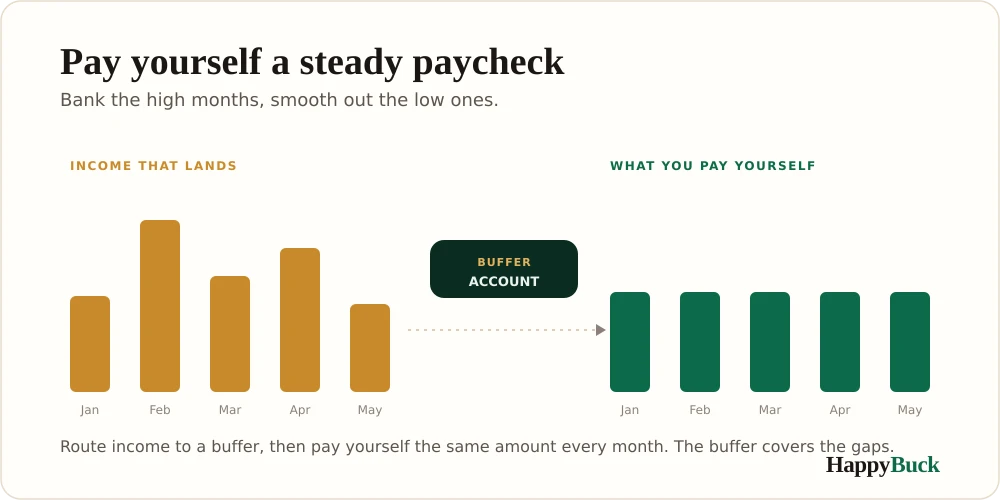
This is the trick that changes everything. Open a separate “buffer” account and route your income there first. Then, once a month, pay yourself a fixed amount into your regular checking, the same number every month, like a salary. You live off that steady paycheck. The buffer absorbs the swings so a feast month and a famine month both feel normal. In a strong month the buffer grows. In a weak month it covers the difference. For the mechanics of giving each dollar a job once it lands in checking, our zero-based budgeting guide pairs perfectly with this.
4. Prioritize the overflow from good months
When you earn more than your baseline, decide in advance where the extra goes so it does not just evaporate. A simple priority order:
- Fill the buffer to one month of expenses, then build toward two or three.
- Fund your emergency fund (a separate, longer-term cushion).
- Attack high-interest debt and then your savings goals.
Writing this list down before the money arrives is what keeps a big month from turning into a big spending month.
5. Set aside taxes if you are self-employed
Tips, freelance, and contract income usually do not have taxes withheld, and a surprise tax bill can wipe out a buffer overnight. Move 25 to 30 percent of self-employment income into a separate tax account as it comes in. Treat it as money that was never yours.
6. Track weekly, not monthly
Variable income moves fast, so check in more often. Fifteen minutes once a week to log what came in and what went out is enough to catch a slow stretch early, while you still have time to ease off spending. A simple spreadsheet handles this well: see our step-by-step guides for Excel and Google Sheets.
A quick example
Say your income over six months ranged from $2,400 to $4,300. You would set your baseline near $2,400, build an essentials budget that fits inside it, and pay yourself, say, $2,500 a month from your buffer. In a $4,300 month, $1,800 flows into the buffer and your priority list. In a $2,400 month, you still pay yourself $2,500 and the buffer quietly covers the $100 gap. Your spending never lurched, even though your income did.
How real people actually do it
I am not the only one who landed here. When I went looking at how others handle a bumpy income, the same playbook kept surfacing. In a r/budget thread on this exact question, the very first answer was simply: “Buffer account.” One commenter ran the math the same way: if you make $1,800 some months and $2,500 to $3,000 in others and need about $2,500 to get by, keep roughly $2,000 set aside to smooth the difference, separate from your emergency fund.
Another, who worked full time in the service industry with no steady weekly check, described making “an imaginary paycheck” to budget from. Take the lowest you would ever make in a week, make sure every bill gets paid out of that number, then reconcile to reality once the week is over. Whatever came in above the baseline went toward something they wanted or into savings.
A third, paid a small base plus wildly variable commission, put it plainly: budget on the flat part of your pay because it is “the only portion that I can truly count on,” cover every necessity with it, and treat commission as extra that mostly goes to savings. Three different jobs, the same instinct. Anchor to the income you can count on, and give everything above it a plan.
The honest caveat
This system needs a runway to work. The buffer is the whole engine, and building that first month of cushion is the hard part, especially if money is already tight. Be patient: start by paying yourself slightly less than your baseline so the buffer can grow, even slowly. And if your essentials genuinely do not fit inside your lowest months, no budgeting trick fixes that alone. That is an income or a fixed-cost problem, and it is worth being honest with yourself about which one. Free, no-hype worksheets from the Consumer Financial Protection Bureau are a solid place to map it out.
Where to go next
- New to budgeting? Start with the guide to budgeting for beginners.
- Want every dollar assigned once it lands? Read what zero-based budgeting is.
- Plan for the irregular bills too, with sinking funds.
- Build the emergency fund your buffer is the first step toward.
- Carrying balances from a lean stretch? Here is how to pay down high-interest debt.
An irregular income is not a reason you cannot budget. It just means you budget in a different order: anchor to your lowest months, pay yourself a steady paycheck, and let the good months do the heavy lifting. Do that, and the swings stop running your life.


