
Sinking Funds Explained (Plus 20 Categories to Start)
A sinking fund saves up for a known expense a little at a time, so the bill never blows up your month. Here is the simple math, 20 categories, and how to start.


A sinking fund is money you set aside a little at a time for a specific, known expense that is coming later. Instead of getting hit with a $1,200 insurance bill all at once, you save $100 a month for twelve months and the bill is already covered when it lands. The whole point is to turn a big, lumpy expense into a small, predictable one, so it never wrecks a single month’s budget.
Most budgets handle the regular monthly bills fine. Where they fall apart is the predictable-but-irregular stuff: the car registration, the holidays, the annual premium, the vet visit. These are not emergencies. You know they are coming. A sinking fund is how you plan for them on purpose instead of reaching for a credit card every time one shows up.
The first time I really leaned on one was for studying abroad. I had planned on going, but when I added up the real cost I could not cover all of it, and housing once I landed was the scary part. So about six months before I left, I started a sinking fund just for that. Every month I moved a set amount into a separate account I treated as off-limits. By the time I flew out, the housing money was already sitting there waiting, instead of being a last-minute panic I had to scramble to solve. That is the whole appeal: a sinking fund turns a scary lump sum into a boring monthly habit.
How a sinking fund works
The math is simple. Take the total cost, divide by the number of months until you need the money, and that is your monthly amount.
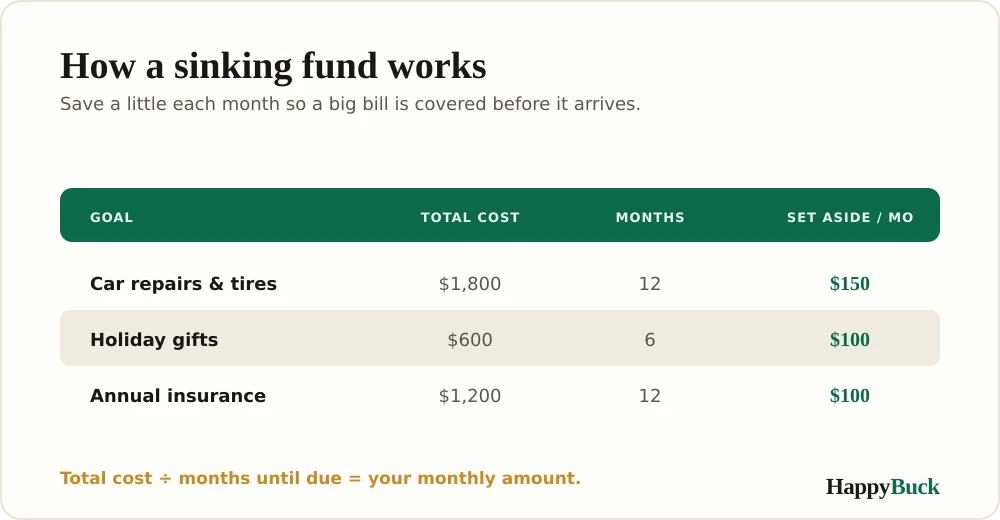
| Goal | Total cost | Months until due | Set aside per month |
|---|---|---|---|
| Car repairs and tires | $1,800 | 12 | $150 |
| Holiday gifts | $600 | 6 | $100 |
| Annual insurance | $1,200 | 12 | $100 |
That is the entire engine: total cost ÷ months until due = monthly set-aside. Save that amount every month and the expense funds itself. No scramble, no debt.
Sinking fund vs emergency fund
People mix these up, but they do different jobs:
- A sinking fund is for a known expense with a rough date and amount. Holidays in December. Insurance in March. You are saving toward something specific.
- An emergency fund is for the unknown: a job loss, a surprise medical bill, the thing you did not see coming. You do not assign it to a category because you do not know what it is for yet.
You want both. The sinking fund keeps planned costs from becoming emergencies, which means you raid the emergency fund far less often.
How to set up a sinking fund in 4 steps
- List what is coming. Scan last year’s statements for the big one-off and annual costs you forgot to plan for. Those are your candidates.
- Price each one and pick a date. Roughly what will it cost, and when do you need it?
- Do the division. Total cost divided by months until due is your monthly amount. Add those up across all your funds so you know the real number.
- Automate it. Move the money the day you get paid, before you can spend it. Out of sight, out of temptation.
20 sinking fund categories to consider
You do not need all of these. Pick the handful that match the expenses that actually catch you off guard.
Home
- Home repairs and maintenance
- Furniture and appliances
- Property taxes
- Annual HOA or home insurance
Car and transportation
- Car maintenance and tires
- Major repairs
- Registration and renewal
- Your next car (down payment)
Health and family
- Medical and dental bills
- Pet care and vet visits
- Childcare gaps and school costs
- Back-to-school shopping
Life and seasonal
- Holidays and gifts
- Vacation and travel
- Birthdays and weddings you are invited to
- Annual subscriptions and memberships
Bigger goals
- Wedding
- Home down payment
- New phone or laptop
- A planned tax bill (if you owe each year)
Where to keep your sinking funds
Keep this money separate from your everyday checking so you are not tempted to spend it, and somewhere it earns a little while it waits. A high-yield savings account is the usual home. Some banks let you split one savings account into labeled “buckets,” which is handy if you would rather track several funds in one place than open a separate account for each. Either approach works. The only rule is that it is not sitting in your spending account.
A simple spreadsheet keeps the targets and monthly amounts straight. Our step-by-step guides for Excel and Google Sheets both include a place to track them.
How other people actually use them
I am not the only one who swears by these. In a r/HENRYfinance thread on sinking funds, people described setups that look a lot like the categories above. One household runs four funds, for Christmas and gifts, cats, vacations, and home, and likes that each one shows a specific number: roughly what they will spend on the holidays this year, or the date a given vacation becomes affordable. Another fills theirs when an annual bonus lands, splitting it across a wedding, vacations, non-optional car and house maintenance, and the optional stuff like furniture.
My favorite was the simplest. One person had quietly been saving a few dollars a month toward an eventual appliance replacement. When their 17-year-old stove finally died, they bought a new one on the spot without a second thought about where the money would come from. As they put it, “Wife was impressed.” That is the quiet payoff of a sinking fund: the day the thing breaks, it is a non-event.
The honest caveat
Sinking funds only help if the monthly amounts actually fit your budget. If you stack up ten of them and the total is more than you can set aside, you have not solved anything, you have just moved the stress earlier. Start with the two or three expenses that hurt the most when they hit, usually car repairs, the holidays, and any annual premium. Get those funded first, then add categories as you have room. A few funds you keep beat a dozen you abandon.
Where to go next
- New to budgeting? Start with the guide to budgeting for beginners.
- Income that changes month to month makes these even more important. Here is how to budget on an irregular income.
- Want every dollar assigned, including these? Read what zero-based budgeting is.
- Build the emergency fund that backs everything up.
A sinking fund is one of the least glamorous and most useful habits in budgeting. It does not require discipline in the moment, just a little math up front and an automatic transfer. Set it once, and the bills that used to ambush you turn into something you already paid for. For free, no-hype worksheets, the Consumer Financial Protection Bureau has solid versions to build from.


