
What Is Zero-Based Budgeting? A Simple Guide
Zero-based budgeting gives every dollar a job until nothing is left unassigned. Here is how it works, who it suits, and how to start your own.


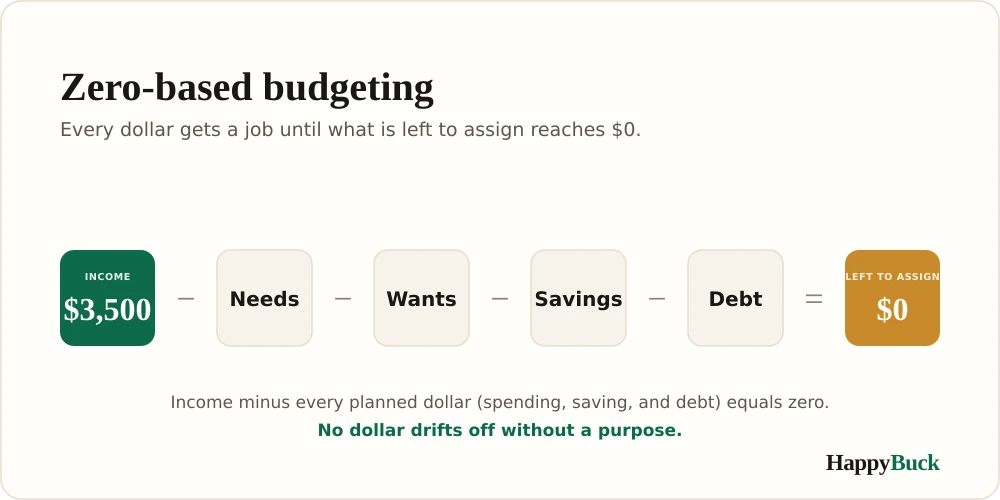
Zero-based budgeting means giving every dollar of your income a specific job until you have zero dollars left unassigned. The math is simple: income minus everything you have planned (spending, saving, and debt) equals zero. It is not about spending every cent. Saving and debt payoff are jobs too. The point is that no dollar drifts off without a purpose.
Most budgets fail in the gaps: the money that lands in checking with no plan attached and quietly disappears. Zero-based budgeting closes those gaps by forcing a decision on every dollar before the month starts. It takes more effort than a percentage rule, but for people who want full control, nothing else comes close.
What zero-based budgeting means
“Zero-based” doesn’t mean your bank account hits zero. It means your plan balances to zero. Every dollar of expected income is assigned to a category, so planned income minus planned outflows is exactly $0. Those categories include the fun stuff and the responsible stuff: rent, groceries, dining out, your emergency fund, retirement, extra debt payments. If you have money left after assigning everything, you aren’t finished. You give that money a job too, usually savings or debt.
How zero-based budgeting works
Start with the income you expect this month. Then subtract every planned dollar until you reach zero:
Income − needs − wants − savings − debt = $0
That is the whole rule. The discipline is doing it before the month, on purpose, instead of spending first and seeing what’s left.
How to make a zero-based budget in 5 steps
- Write down your expected take-home pay for the month. If your income varies, use a conservative number.
- List every expense and goal: fixed bills, variable spending, savings, and debt payoff.
- Assign a dollar amount to each until your income is fully allocated.
- Keep going until the money left to assign is exactly zero.
- Track as you spend, and move money between categories when life happens. Reassigning is part of the system, not a failure.
A zero-based budget example
Say you bring home $3,500 this month. A zero-based plan might look like this:
| Category | Assigned |
|---|---|
| Rent | $1,200 |
| Groceries | $400 |
| Utilities and phone | $250 |
| Transportation | $200 |
| Dining and fun | $300 |
| Emergency fund | $300 |
| Retirement | $350 |
| Extra debt payment | $400 |
| Buffer and miscellaneous | $100 |
| Total assigned | $3,500 |
| Left to assign | $0 |
Every dollar has a name. That is the entire idea.
Who zero-based budgeting is best for
It shines if you want maximum control and visibility, if your income is fairly predictable, or if you have tried looser methods and still wondered where your money went. Couples often like it because the plan is explicit, so there is less to argue about later.
Zero-based vs 50/30/20
The 50/30/20 rule sorts money into three broad buckets by percentage. Zero-based budgeting is more granular: instead of three slices, you assign every individual category. 50/30/20 is easier to maintain. Zero-based is more precise. Plenty of people start with 50/30/20 and graduate to zero-based once they want tighter control. Neither is “better.” The best one is the one you will actually keep doing. If you are still weighing your options, here is all three methods compared side by side.
Where it fell short for me
Let me put it plainly: zero-based budgeting wasn’t for me. It works for plenty of people, but my brain just doesn’t operate that way, and assigning every single dollar a job never quite clicked. Early on, when I was bartending, my pay was sporadic. I rarely knew exactly what my take-home would be from one week to the next, and zero-based budgeting really wants that number to be steady. Without the guarantee, the plan fell apart almost as fast as I built it.
What worked for me instead was looser: cover the main expenses first, then put aside enough to actually enjoy my life and save a little, whatever I could manage that month. Less precise, but I stuck with it, and consistency beats precision every time.
So be honest with yourself before you commit. Zero-based budgeting is high-maintenance, and if your income is unpredictable, the constant reassigning can wear you down. If that sounds exhausting, a simpler framework or a pay-yourself-first approach may keep you consistent where zero-based would just make you quit.
How to start
The easiest on-ramp is a simple spreadsheet. Our step-by-step guides for Excel and Google Sheets walk through the exact setup, and you can adapt either one to zero out every month.
More from HappyBuck
- New to all this? Start with the guide to budgeting for beginners.
- Build the emergency fund your plan keeps funding.
- Putting extra dollars toward balances? Here’s how to pay down high-interest debt.
Zero-based budgeting is the most thorough way to run your money, and also the most demanding. If you want the control, it is worth the effort. If you want something you will still be doing in six months, be honest about that and pick the method that fits. For free worksheets to start from, the Consumer Financial Protection Bureau has solid, no-hype versions.


