
50/30/20 vs Zero-Based vs Envelope: Which Budget Is Right for You?
The three most popular budgeting methods, compared side by side. See how 50/30/20, zero-based, and envelope budgeting differ, and which one fits how your brain works.


The three most popular budgeting methods are the 50/30/20 rule, zero-based budgeting, and the envelope system. The short version: 50/30/20 is the simplest and best for beginners, zero-based gives you the most control, and the envelope system is best if you overspend and need hard limits. None is objectively better than the others. The right one is the one that matches how your brain works, because the only budget that helps is the one you actually keep using.
Below is how each method works, a side-by-side comparison, and a simple way to pick. The good news is you are not locked in. Plenty of people mix them, and switching later is easy.
The three methods at a glance
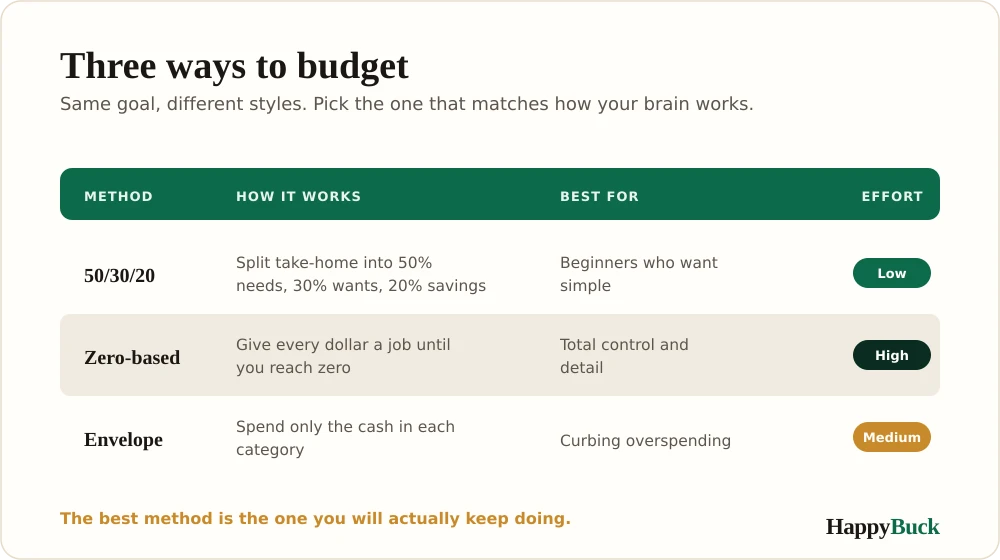
| Method | How it works | Best for | Effort | Watch out for |
|---|---|---|---|---|
| 50/30/20 | Split take-home pay into 50% needs, 30% wants, 20% savings and debt | Beginners who want a simple frame | Low | Too broad to catch one category quietly leaking |
| Zero-based | Assign every dollar a job until income minus outflow is zero | People who want total control | High | The most upkeep of the three |
| Envelope | Spend only the cash allotted to each category | Curbing overspending on variable costs | Medium | Cash earns nothing and does not build credit |
The 50/30/20 rule
You split your take-home pay into three buckets: 50 percent to needs, 30 percent to wants, and 20 percent to savings and debt. That is the whole system. On a $4,000 take-home month, that is $2,000 for needs, $1,200 for wants, and $800 toward savings and debt.
- Best for: beginners, and anyone who wants a budget that takes ten minutes to set up and almost no maintenance.
- The tradeoff: it is a blunt instrument. Three broad buckets will not catch a specific category quietly bleeding money.
- Go deeper: our guide to budgeting for beginners walks through the 50/30/20 setup step by step.
Zero-based budgeting
You give every single dollar a job before the month starts, until your income minus everything you have planned equals zero. Savings and debt payoff count as jobs too. Bring home $3,500 and you assign all $3,500 across rent, groceries, savings, debt, and fun until nothing is left unassigned.
- Best for: detail-oriented people who want total control and visibility, and couples who want the plan spelled out.
- The tradeoff: it is the most work. You plan up front and adjust as the month moves, which not everyone has the patience for.
- Go deeper: here is what zero-based budgeting is and how to start one.
The envelope system (cash stuffing)
You divide your spending money into labeled envelopes, one per category, and spend only what is in each. When an envelope is empty, you stop. Put $500 of cash in a groceries envelope, and once it is gone, you are done buying groceries until next month. It is usually done with physical cash, though a digital version works too.
- Best for: people who consistently overspend on variable categories and want a hard, physical stop.
- The tradeoff: cash is inconvenient, earns no interest, and does not build credit. It suits discretionary spending, not fixed bills.
- Go deeper: here is how cash stuffing works, including the digital version and the downsides.
How to choose
Pick based on the problem you are actually trying to solve:
- You want simple and low-effort. Start with 50/30/20. It is the easiest on-ramp, and you can always get more precise later.
- You want to know where every dollar goes. Use zero-based. Nothing else gives you that level of control.
- You overspend no matter what you plan. Use the envelope system on your problem categories. The physical limit is the point.
- Your income changes month to month. Start with the baseline approach in our irregular income guide, then layer one of these on top.
You can combine them
This is what most experienced budgeters actually do. The methods are not mutually exclusive:
- Use 50/30/20 as your overall frame so the big proportions stay sane.
- Use zero-based thinking inside the wants bucket, where money tends to leak.
- Use envelopes for the two or three categories you personally overspend on, like dining out or groceries.
- Automate savings first with pay yourself first, so the plan does not depend on willpower.
Mixing is not cheating. It is how you build a budget around your actual weak spots instead of forcing yourself into someone else’s system.
The honest part
I have tried the strict end of this and bounced off it. Zero-based budgeting never clicked for me, and I never took to cash envelopes either, since I would rather scroll my bank app and see exactly where the money went. What stuck was looser: cover the essentials first, automate a little savings, and keep the rest simple enough that I would actually keep doing it. That is the real lesson here. The method matters far less than the streak. A simple budget you follow for a year beats a perfect one you quit in March.
Where to go next
- Ready to start? The budgeting for beginners guide sets up your first 50/30/20 plan.
- Want maximum control? Read what zero-based budgeting is.
- Overspending on the day-to-day? Try cash stuffing.
- Plan for the irregular bills with sinking funds, and build your emergency fund alongside any method.
There is no trophy for picking the “correct” budget. Try the one that fits your temperament, give it a couple of months, and adjust. For free, no-hype worksheets to start from, the Consumer Financial Protection Bureau has versions for whichever method you land on.
Frequently asked questions
Which budgeting method is best for beginners?
The 50/30/20 rule is the best starting point. It takes about ten minutes to set up, needs almost no maintenance, and splits your take-home pay into just three buckets: 50 percent needs, 30 percent wants, and 20 percent savings and debt. You can always move to a more detailed method later.
What is the easiest budgeting method?
The 50/30/20 rule is the easiest because it only has three categories and runs on percentages, so there is very little to track. The envelope system and zero-based budgeting give you more control but take more effort to maintain.
Is zero-based budgeting better than the 50/30/20 rule?
Neither is better in general. Zero-based budgeting gives you more precision and control because every dollar is assigned a job, but it takes more work each month. The 50/30/20 rule is simpler and easier to stick with. The best choice depends on how much detail you want and how much upkeep you will actually keep up with.
Can you combine budgeting methods?
Yes, and many experienced budgeters do. A common combination is using the 50/30/20 rule as the overall frame, applying zero-based thinking to the categories that leak money, and using cash envelopes for the two or three categories you tend to overspend on. Combining methods lets you build a budget around your actual weak spots.
Which budgeting method is best for an irregular income?
When your income changes month to month, start by setting a baseline off your lowest typical month and pay yourself a steady amount from a buffer account. Once income lands in checking, any of the three methods can sit on top, though zero-based budgeting pairs especially well because it assigns every dollar as it arrives.


