
Balance Transfer Cards: How They Work (and the Catch)
A 0% balance transfer can save you real money on credit card debt, or trap you deeper if you use it wrong. Here is exactly how they work and the catch to watch for.


A balance transfer card lets you move high-interest credit card debt onto a new card with a 0 percent introductory APR, so for a set window, often 12 to 21 months, every dollar you pay goes to the balance instead of interest. You pay a one-time transfer fee, usually 3 to 5 percent of the amount moved, and then race to pay off as much as you can before the regular rate kicks in. Done right, it can save you hundreds or thousands. Done wrong, it just moves your debt around and adds a fee.
The whole value is in that interest-free window. It is a tool for people with a real payoff plan, not a way to make debt disappear.
How a balance transfer works
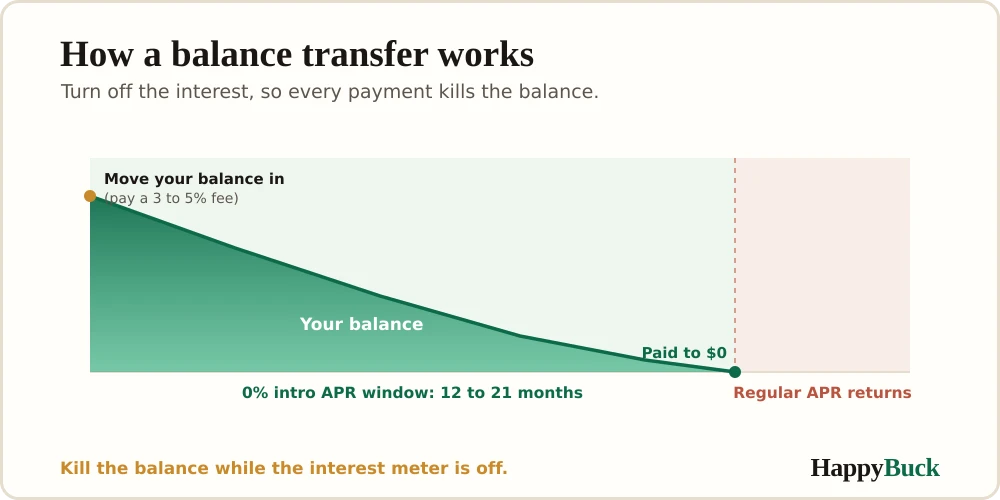
- You open a balance transfer card with a 0 percent intro APR offer.
- You move your high-rate balances onto it and pay a transfer fee of about 3 to 5 percent.
- For the intro period, you pay no interest, so your whole payment attacks the principal.
- Before the intro period ends, you pay the balance off, or as much as possible, because leftover balances start accruing interest at the card’s regular high rate.
On a $6,000 balance at 22 percent, the interest you would have paid dwarfs a 3 to 5 percent transfer fee, which is why the math usually works, if you actually pay it down in time.
When it makes sense
A balance transfer is a good move when all of these are true:
- You have high-interest debt you are serious about clearing.
- You can realistically pay off most or all of it during the 0 percent window.
- You will stop charging the cards you just paid off.
If that is you, this is one of the most effective tools for beating credit card debt, because it turns off the interest meter while you work.
The catch to watch for
Balance transfers trip people up in three predictable ways:
- The fee. That 3 to 5 percent is real. It is usually worth it, but factor it in.
- The clock. The 0 percent rate ends. Whatever balance is left when it does starts racking up interest at the full rate, so make a payoff plan that finishes before the deadline.
- The temptation. A freshly paid-off card with a big limit is bait. If you run the old cards back up, you now have two balances instead of one. Discipline is the price of admission.
What it looks like in practice
I have never carried credit card debt myself, but this is exactly the situation these cards are built for. In a r/debtfree thread, someone described chipping away at $9,000 across three cards, already down from $15,000, without a single new charge in over a year, but feeling stuck because 22 to 25 percent interest was slowing every payment. The top suggestion was simple: move it to a no-interest balance transfer card for about 15 months. Two other commenters jumped in to say they had done exactly that, one of them noting, “Paid off 12k on a no interest card.”
Notice the common thread in every success story: they had already stopped charging the cards and had a plan to pay the balance down. The balance transfer did not fix their spending. It switched off the interest so their existing effort could finally land. That is the whole difference between a balance transfer that works and one that just moves your debt around.
Balance transfer vs consolidation loan
Both lower the rate you are fighting, but differently. A balance transfer gives you a temporary 0 percent window on a credit card, best for debt you can clear fast. A consolidation loan gives you one fixed lower rate and payment over a set term, better for larger balances you need more time to pay down. Which fits depends on how much you owe and how quickly you can pay.
Where to go next
- The debt this is built to fight: how to pay off credit card debt.
- The other rate-lowering option: debt consolidation.
- The full plan to get out of debt.
A balance transfer is a genuinely useful tool, but it is a tool, not a fix. Use the 0 percent window to kill the principal, avoid the temptation to recharge, and finish before the clock runs out. Treated that way, it can knock months and real money off your payoff. For unbiased basics on how these cards work, the Consumer Financial Protection Bureau is a solid, no-sales-pitch source.
Frequently asked questions
How does a balance transfer card work?
You open a card with a 0 percent introductory APR on balance transfers, then move your existing high-interest balances onto it. For the intro period, often 12 to 21 months, you pay no interest, so every payment goes straight to the principal. You usually pay a one-time transfer fee of around 3 to 5 percent of the amount moved.
Is a balance transfer worth it?
It can be, if you have a solid plan to pay off the balance during the 0 percent window. The interest you save usually dwarfs the 3 to 5 percent transfer fee. It is not worth it if you will only make minimum payments, keep charging the old cards, or let the balance sit until the regular rate kicks in.
What is the catch with balance transfer cards?
Three things. There is a transfer fee of about 3 to 5 percent. The 0 percent rate is temporary, and whatever is left when it ends starts accruing interest at the regular high rate. And a new card with available credit tempts some people to run up new debt on the old cards. The card only helps if you pay the balance down and stop charging.
Does a balance transfer hurt your credit score?
There is usually a small, temporary dip from the new-card application, but the effect is often positive over time. Moving debt onto a new card with a high limit can lower your overall credit utilization, which helps your score, as long as you do not run the old cards back up.


