
Debt Consolidation: When It Helps and When It Hurts
Debt consolidation rolls several debts into one payment, ideally at a lower rate. It can genuinely help, or quietly make things worse. Here is how to tell the difference.


Debt consolidation means rolling several debts into a single new loan or balance, ideally at a lower interest rate, so you make one payment instead of juggling five. The tools are usually a personal consolidation loan, a balance transfer card, or sometimes a home equity loan. Done for the right reasons, it lowers your rate and simplifies your life. Done for the wrong ones, it just reshuffles your debt, adds a longer term, and quietly costs you more. The tool is neutral. The outcome depends on how you use it.
The key thing to understand up front: consolidation does not reduce what you owe. It changes the rate, the term, and the number of payments. That can be a real help, but it is not debt relief, and anyone selling it as magic is not being straight with you.
How debt consolidation works
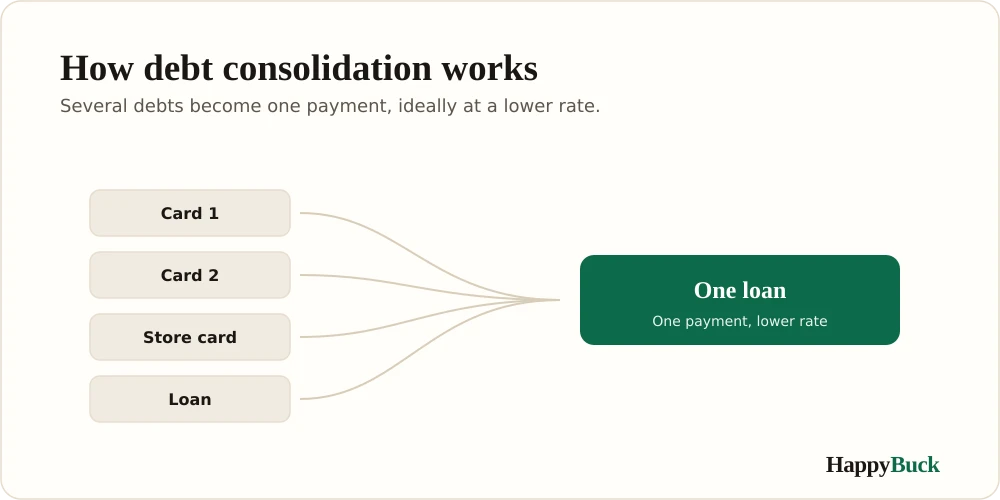
You take out one new loan large enough to pay off your existing debts, use it to clear them, and then you are left with a single monthly payment on the new loan. If that new loan has a lower rate than the debts it replaced, more of each payment goes to principal, and you get out faster and cheaper. If it does not, you have mostly just simplified your bills.
When consolidation genuinely helps
Consolidation is a good move when all of these are true:
- The new rate is meaningfully lower than the average rate on your current debts.
- You can afford the new monthly payment comfortably.
- The term is not so long that a lower rate still costs you more overall.
- You stop using the cards you just paid off.
That last one is where most consolidations succeed or fail. Paying off your cards with a loan and then running the cards back up leaves you with the loan and new card debt. Consolidation works when it is the last step of a plan, not a reset button.
When it hurts (and what to avoid)
- A barely-better rate. If the new loan is not much cheaper, the fees and hassle may not be worth it.
- Stretching the term too far. A lower payment over a much longer term can mean you pay more total interest, even at a lower rate. Check the total cost, not just the monthly number.
- Borrowing against your home. A home equity loan can offer a low rate, but it turns unsecured debt into debt secured by your house. Miss payments and you are risking your home to pay off a credit card. Tread very carefully.
- For-profit debt settlement dressed up as “consolidation.” This is the big one. Companies that promise to slash your debt for a fee often tell you to stop paying your creditors, which tanks your credit and can leave you worse off. That is settlement, not consolidation, and it is worth deep skepticism. For genuine help, start with nonprofit credit counseling through the NFCC.
Is consolidation right for you?
Ask three questions: Does it actually lower my rate? Can I afford the payment? Will I stop adding new debt? Three yeses, and consolidation can accelerate your payoff. Any nos, and you are better off attacking your debt directly with the snowball or avalanche method and freeing up money from your budget.
Where to go next
- The simpler rate-lowering tool for smaller balances: balance transfer cards.
- Pick your payoff order: snowball vs avalanche.
- The full plan to get out of debt.
Debt consolidation can be a smart accelerator or an expensive detour, and the difference is almost entirely about the rate, the term, and whether you stop borrowing. Run the numbers, read the fine print, and be ruthless about anyone promising to make your debt vanish. For unbiased guidance, the FTC explains your real options with no sales pitch.
Frequently asked questions
What is debt consolidation?
Debt consolidation combines multiple debts into a single new loan or balance, ideally at a lower interest rate, so you have one payment instead of several. Common tools include a personal consolidation loan, a balance transfer card, or a home equity loan. It simplifies your debts and can lower your rate, but it does not erase what you owe.
Does debt consolidation hurt your credit?
Usually there is a small, temporary dip from the new-loan application, then a neutral-to-positive effect if you make payments on time and lower your credit utilization. Consolidation only hurts your credit if you miss payments on the new loan or run your old cards back up after paying them off.
Is debt consolidation a good idea?
It is a good idea when it genuinely lowers your interest rate, you can afford the new payment, and you stop adding new debt. It is a bad idea if the new rate is not much better, the term is so long that you pay more overall, or it just frees up your old cards to run up again. The tool is only as good as the behavior behind it.
What is the difference between debt consolidation and debt settlement?
Debt consolidation combines your debts into one new loan you still pay in full, usually at a lower rate. Debt settlement is when a company negotiates to pay less than you owe, often telling you to stop paying first, which can wreck your credit and come with big fees. Consolidation is a mainstream tool; for-profit settlement is high-risk and worth deep skepticism.


