
Debt Snowball vs Debt Avalanche: Which Payoff Method Wins?
The snowball pays your smallest balance first for momentum. The avalanche pays your highest rate first to save the most money. Here is how each works and which to pick.


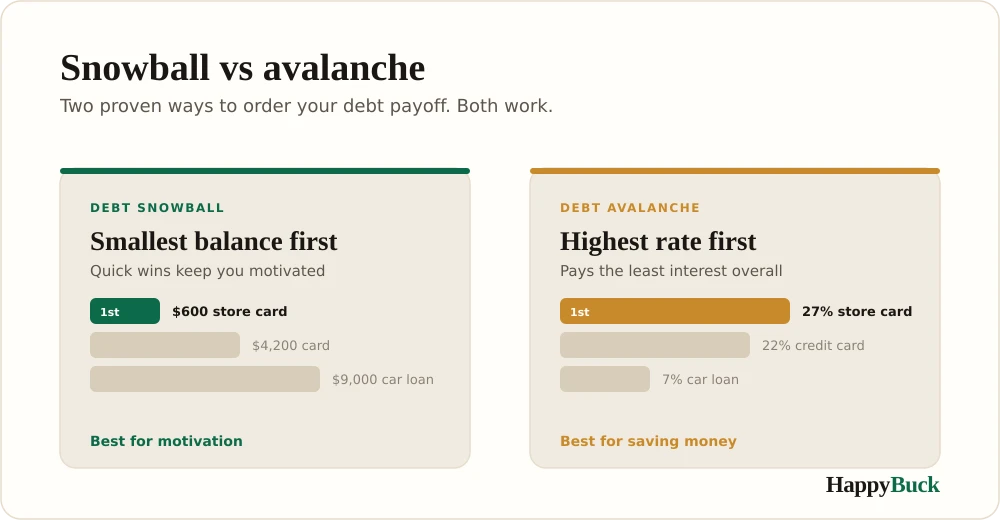
The debt snowball and the debt avalanche are the two most popular ways to pay off debt, and they work the same way with one key difference: the order. Both have you pay the minimum on every debt, then throw every extra dollar at one target debt until it is gone, then roll that payment to the next. The snowball targets your smallest balance first for a quick, motivating win. The avalanche targets your highest interest rate first to save the most money. That is the whole debate.
Neither is wrong. One optimizes for your wallet, the other for your willpower, and the right pick depends on which one will actually get you to zero.
How each method works
| Method | Pay off first | Wins on | The tradeoff |
|---|---|---|---|
| Debt snowball | Smallest balance | Motivation and quick wins | Costs a little more interest |
| Debt avalanche | Highest interest rate | Least interest paid | The first win takes longer |
The debt snowball: momentum first
With the snowball, you ignore interest rates and line your debts up from smallest balance to largest. You attack the smallest one with everything extra while paying minimums on the rest. When it is gone, you take that whole payment and roll it onto the next-smallest, which is why it “snowballs.”
The magic is psychological. Wiping out an entire debt in the first month or two feels amazing, and that feeling is what keeps people going. If you have tried to pay off debt before and lost steam, the snowball is probably your method.
The debt avalanche: math first
With the avalanche, you order your debts by interest rate, highest to lowest, and attack the highest rate first. Because interest is what makes debt expensive, killing the priciest debt first means you pay the least overall and usually get out of debt slightly faster.
The catch is that your highest-rate debt is not always your smallest, so the first win can take a while. If you are motivated by numbers and can stay patient, the avalanche is the mathematically optimal choice.
A quick example
Say you have a $600 store card at 27 percent, a $4,200 credit card at 22 percent, and a $9,000 car loan at 7 percent. The snowball kills the $600 store card first for a fast win, then the credit card, then the car. The avalanche also starts with the store card (it happens to be both smallest and highest-rate here), then attacks the 22 percent credit card before the 7 percent car loan. When your smallest debt is also your highest-rate, both methods agree. When they differ, the avalanche saves you money and the snowball saves your motivation.
So which should you pick?
Be clear-eyed with yourself about what drives you. Personally, I lean toward the avalanche logic. My student loans were low-interest, so I never rushed to crush them, since throwing money at a cheap loan while higher-rate debt or goals existed would not have made sense. That is avalanche thinking: attack what costs the most first. But I have watched the snowball carry people who had quit every other plan, purely because the early win kept them in the game.
If you want the cheapest path and can stay patient, run the avalanche. If you need to feel progress to keep going, run the snowball. And if you cannot decide, do the hybrid: knock out one tiny balance for the motivation, then switch to attacking by interest rate.
Dig deeper
- New to this? Start with the full plan to get out of debt.
- Cards are usually the highest-rate target: how to pay off credit card debt.
- Want to lower the rate you are fighting? See balance transfer cards.
- Not sure whether to save or pay debt first? Here is the order.
The snowball and the avalanche are both good answers to the same question. One saves the most money, the other keeps the most people going. Pick the one that fits how your brain works, stay consistent, and roll each freed-up payment into the next debt. That rollover is the real engine, no matter which order you choose. For an unbiased overview, the FTC’s guide to paying off debt is a solid reference.
Frequently asked questions
What is the difference between the debt snowball and debt avalanche?
The debt snowball pays off your debts from smallest balance to largest, regardless of interest rate, so you get quick wins that keep you motivated. The debt avalanche pays off your highest-interest debt first, which costs you the least in interest overall. Both use the same core move: pay minimums on everything, then throw all extra money at one target debt.
Which is better, the snowball or the avalanche?
The avalanche saves you the most money mathematically, since it kills your highest-interest debt first. The snowball usually keeps people motivated better because of the early wins. The best method is the one you will stick with to the end, so pick based on whether you are driven more by math or by momentum.
Does the debt snowball really work if it costs more interest?
Yes, for a lot of people. The extra interest from the snowball is usually modest, and the quick first win can be the difference between finishing and quitting. If motivation is what makes or breaks your payoff, the snowball can easily beat a "cheaper" avalanche you abandon halfway.
Can you combine the snowball and avalanche methods?
Yes. A common hybrid is to knock out one tiny balance first for the motivation, then switch to the avalanche and attack by interest rate from there. You get an early win and most of the interest savings. The methods are guidelines, not rules, so build the version you will keep doing.


