
How to Pay Off Credit Card Debt (Fast and For Good)
Credit card debt is the most expensive kind, and minimum payments are designed to keep you in it. Here is how to pay it off, and keep it gone.


To pay off credit card debt, stop making only the minimum payment, free up as much money as you can, and throw it at your highest-rate card first while paying minimums on the others. Stop adding new charges, and if you can, move the balance to a lower rate so more of each payment kills the principal instead of feeding interest. Credit card debt is the most expensive debt most people carry, which is exactly why it is the first thing to attack.
The reason it feels impossible is not you. It is the math. At a 20-plus percent interest rate, minimum payments are structured so that most of your money goes to interest and the balance barely moves. Beating credit card debt means breaking out of that trap on purpose.
The minimum payment trap
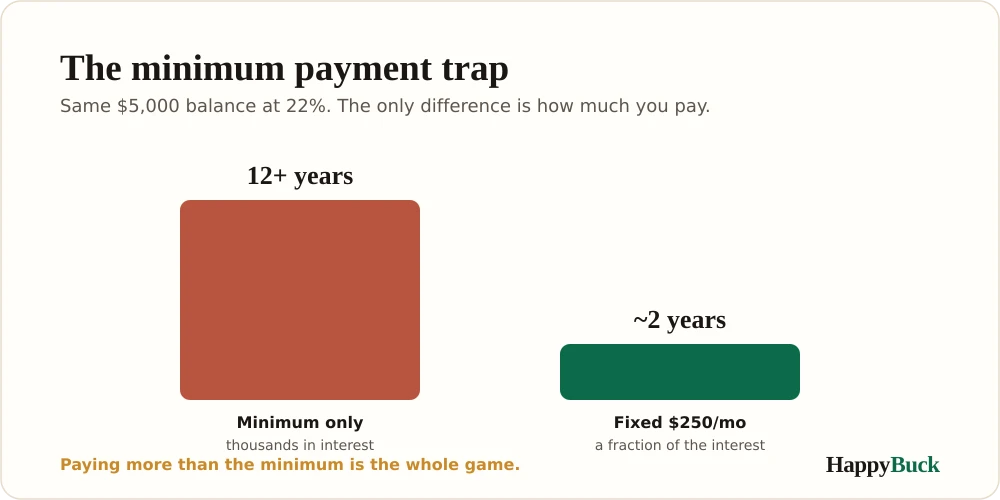
Here is the trap in numbers. A $5,000 balance at 22 percent, paying only the minimum, can take well over a decade to clear and cost thousands of dollars in interest. Pay a fixed $250 a month instead, and the same balance is gone in about two years for a fraction of the interest. Same debt, wildly different outcome, and the only variable is paying more than the minimum. The minimum is the credit card company’s plan for your money. A fixed, higher payment is yours.
How to pay off credit card debt, step by step
- List your cards with the balance, interest rate, and minimum for each.
- Keep a $1,000 starter fund so the next surprise does not go straight back on a card.
- Free up money by trimming your budget and lowering your bills. Every extra dollar is ammunition.
- Pick a method. Pay minimums on all cards, then attack one with everything extra. The avalanche (highest rate first) saves the most on cards, since their rates are so high.
- Stop charging the cards. You cannot outrun a balance you keep adding to.
- Roll each win forward. When one card hits zero, add its payment to the next.
Lower the interest rate you are fighting
The higher your rate, the more of your payment gets eaten before it touches the balance. Two ways to lower it:
- A balance transfer card with a 0 percent intro period lets you pay down the principal with no interest for a while. It only works if you actually pay it off before the rate jumps. Here is how balance transfer cards work.
- A consolidation loan can swap several high-rate cards for one lower fixed rate and payment. See when debt consolidation helps and when it hurts.
Neither erases the debt. They just make more of your payment count, so you get out faster.
What it looks like in practice
I have never carried credit card debt myself, but a thread on r/povertyfinance captured the real version of this better than any calculator. Someone asked how to get out of credit card debt while only making minimum payments. The most upvoted answer did not sugarcoat it:
“You don’t. My husband and I paid off a ton of credit card debt by consolidating it into a loan with our bank that we use for our checking accounts. HOWEVER, if you do this, you CANNOT use your credit cards. Cut them up. Hide them if you want to have that option for TRUE emergencies. But do NOT use them while you’re paying off this consolidation loan. We did it because it cut our interest rate by more than half. We dumped every penny we could into it at the end of the month. It was rough, I’m not gonna lie, but when it was gone it was the best feeling ever.”
That answer is the whole playbook in one paragraph. Minimum payments alone are not a plan, they are the trap. What got them out was three things: lowering the rate (a consolidation loan that cut their interest by more than half), refusing to add new charges (cut up the cards), and throwing every spare dollar at the balance. The lower rate mattered, but it only worked because they stopped using the cards. That is the part people skip, and it is the part that makes or breaks it.
Keep it gone
Paying off the balance is half the job. Staying out is the other half. Keep the cards open (closing them can hurt your credit score by raising your utilization), but treat them like debit cards, paying the full statement balance every month so you never pay interest again. Used that way, a credit card is a convenient tool with rewards. Carried month to month, it is the most expensive money you will ever borrow.
Related reads
- Fit this into the bigger plan to get out of debt.
- Choose your attack order: snowball vs avalanche.
- Lower the rate: balance transfer cards or debt consolidation.
- Build the cushion that keeps you off the cards: emergency fund basics.
Credit card debt is beatable, and it is worth beating first, because nothing else in your budget costs 22 percent. Get a small cushion in place, pay well above the minimum, lower the rate if you can, and stop feeding the balance. Do that and the trap that felt permanent starts falling apart fast. For free help, nonprofit credit counseling through the NFCC is a legitimate place to start.
Frequently asked questions
What is the fastest way to pay off credit card debt?
Pay far more than the minimum and target your highest-rate card first (the avalanche method), while paying minimums on the rest. Free up money from your budget to throw at it, stop new charges on the cards, and consider a lower-rate option like a balance transfer to make more of each payment go to principal instead of interest.
Why is credit card debt so hard to pay off?
Because minimum payments are designed that way. At a typical 20-plus percent APR, most of a minimum payment goes to interest, so the balance barely moves and can take decades to clear. The math only flips in your favor when you pay well above the minimum.
Should I pay off credit cards or save first?
Keep a small starter emergency fund of around \$1,000 first, so a surprise does not send you right back to the cards, then attack the credit card debt aggressively. Credit card interest is so high that, once you have that small cushion, paying it down beats almost any guaranteed return you could earn saving.
Does paying off credit card debt help my credit score?
Yes, usually a lot. Paying down balances lowers your credit utilization, which is one of the biggest factors in your score. Keep the cards open after you pay them off, since closing them can raise your utilization and shorten your credit history.


