
Should You Save or Pay Off Debt First?
Save or pay off debt first? The answer is a little of both, in order. Here is the sequence that keeps a surprise from undoing your debt progress.


Should you save or pay off debt first? The answer is a little of both, in a specific order: build a small starter emergency fund of about $1,000, then throw everything at your high-interest debt, then go back and build your full emergency fund. That sequence solves the core problem, which is that saving and paying off debt seem to compete but actually depend on each other. Skip the small fund and one surprise sends you right back into debt. Skip the debt payoff and high interest quietly drains you.
The order of operations
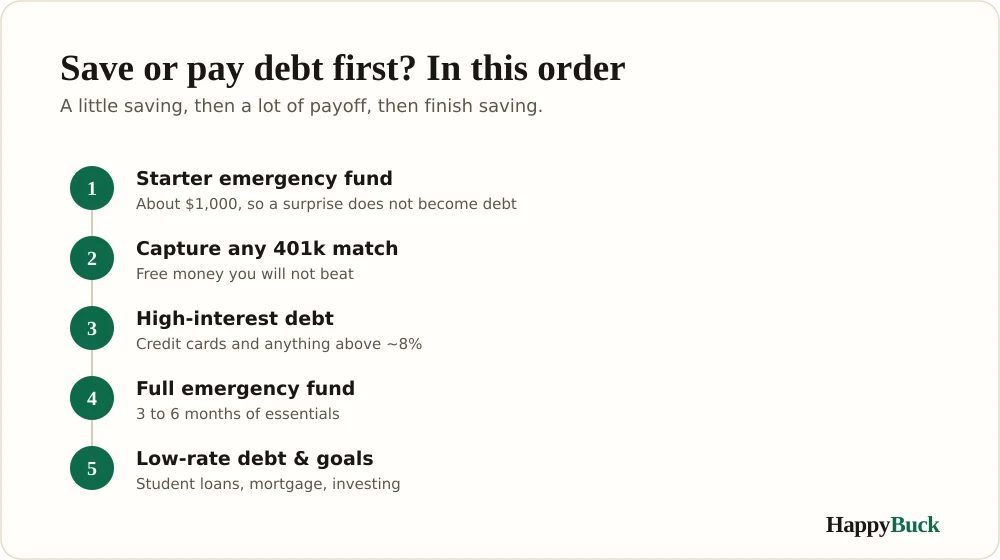
- Starter emergency fund (about $1,000). Small, fast, and non-negotiable. This is the buffer that keeps a flat tire from becoming a credit card balance. On a very tight budget, even $300 to $500 works to start.
- Employer match, if you have one. If your job matches 401k contributions, put in enough to capture it. That is an instant return you will not beat.
- High-interest debt. Now attack it hard. Credit cards and other high-rate debt cost more than almost anything you could earn saving or investing, so clearing them is the highest-guaranteed-return move you have. Use the snowball or avalanche method.
- Full emergency fund (3 to 6 months). With the expensive debt gone, build the real cushion that protects you from bigger shocks.
- Low-interest debt and goals. Student loans, a mortgage, and investing for the future. These are low-urgency, so pay them steadily and let your money also work elsewhere.
Why the small fund comes first
It feels backwards to save while you owe money at 22 percent. But without any cushion, the very next unexpected expense goes straight onto a card, and you undo the progress you just made. A small buffer breaks that loop. It is not about the interest you earn on $1,000, it is about not creating $1,000 of new debt the next time life happens.
Why high-interest debt comes before more saving
Once that starter fund exists, high-interest debt wins the math easily. Paying off a 22 percent credit card is a guaranteed 22 percent return, which no savings account or safe investment comes close to. So you pause the bigger savings goal, kill the expensive debt, then come back and finish the emergency fund. Low-interest debt is different: a cheap student loan or mortgage does not need to jump the line, so pay those on schedule while you build savings and invest.
Where to go next
- Build that starter cushion: emergency fund basics.
- Attack the expensive stuff: how to pay off credit card debt.
- Pick your method: snowball vs avalanche.
- The full plan to get out of debt.
Save or pay off debt first is a false choice. You do a little saving to protect yourself, then a lot of debt payoff to get free, then finish your savings. Follow the order, and each step makes the next one easier. For a free, unbiased framework, the CFPB has solid tools for both saving and debt.
Frequently asked questions
Should I save or pay off debt first?
Do both, in order. First save a small starter emergency fund of about \$1,000, then attack your high-interest debt aggressively, then go back and build a full three-to-six-month emergency fund. The small fund first keeps a surprise from sending you deeper into debt, and paying off high-interest debt beats almost any return you could earn saving.
How much should I save before paying off debt?
Around \$1,000 as a starter fund, or a bit less on a very tight budget. The goal is just enough to cover a common emergency, a car repair or a medical copay, so you do not have to reach for a credit card and undo your progress. You build the larger emergency fund after the high-interest debt is gone.
Should I stop investing to pay off debt?
Usually keep contributing enough to get any employer 401k match first, since that is free money, then focus extra cash on high-interest debt before investing more. For low-interest debt like most student loans or a mortgage, investing alongside steady payments often makes more sense than rushing the payoff.
Is it better to have savings or no debt?
You want a small amount of both working together. A little savings protects you from taking on new debt, and paying off high-interest debt frees up money and removes a guaranteed high cost. The sweet spot is a starter emergency fund plus an active plan to eliminate expensive debt, not one at the total expense of the other.


