
Emergency Fund: How Much You Need and How to Build One
An emergency fund keeps a surprise from becoming debt. Here is how much you need, how to build it without straining your budget, and where to keep it.


An emergency fund is a stash of cash set aside for life’s unexpected expenses, a job loss, a car repair, a medical bill, so that a surprise does not turn into debt. How much should you have? Start with a $1,000 starter fund, then build toward three to six months of your essential expenses. Keep it in a separate high-yield savings account, automate contributions, and leave it alone until an actual emergency hits. That is the whole thing, and it is one of the highest-leverage money moves you can make.
The reason an emergency fund matters so much is what happens without one. With zero cushion, every surprise goes on a credit card, and then the payments eat into next month’s budget, which leaves you thinner for the next surprise. A few hundred dollars in savings breaks that loop before it starts.
I learned this firsthand with a car I probably should not have bought. When I was younger I stretched myself a little thin to get a white BMW 335xi. I could handle the payments fine, but what I did not know was that those engines are notorious for problems. Sure enough, a repair came up, and it ran $2,200. I did not have a ton saved, but I had enough to cover it, partly because I was living at home and keeping my costs low. It was such a fun car, but if that cushion had not been there, a $2,200 bill on top of car payments would have gone straight onto a credit card. The emergency fund is the only reason the repair stayed a bad week instead of the start of a debt spiral.
How much emergency fund do you need?
The classic guidance is three to six months of essential expenses. But the right number for you depends on how stable your income is and how many people depend on it.
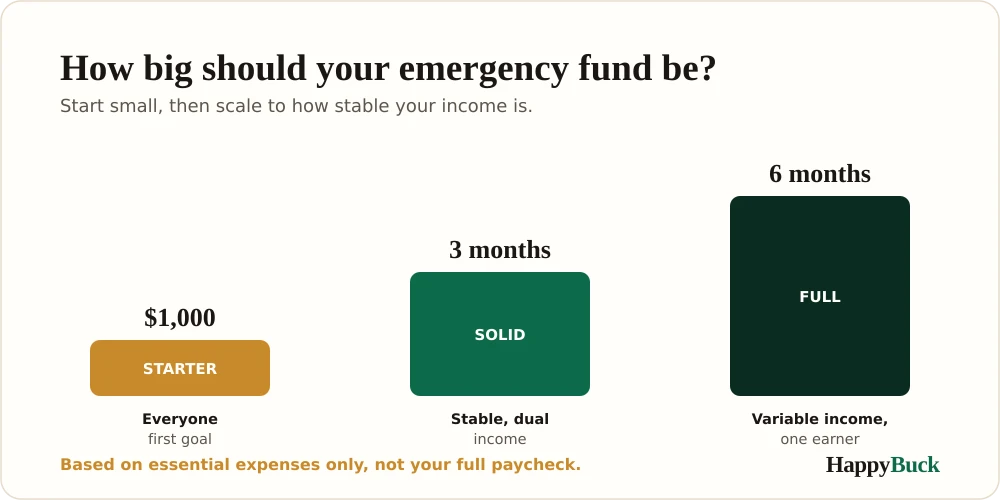
| Your situation | Target emergency fund |
|---|---|
| Just getting started, or paying off debt | $1,000 starter fund |
| Stable job, dual income, few dependents | 3 months of essentials |
| Single earner, dependents, or secure but cautious | 4 to 6 months of essentials |
| Variable income (freelance, tips, commission) or self-employed | 6+ months of essentials |
Notice the word “essentials.” Your emergency fund covers what you need to keep the lights on: housing, utilities, groceries, transportation, insurance, and minimum debt payments. It is not meant to replace your entire lifestyle, so leave out dining out, subscriptions, and travel when you do the math.
How to build an emergency fund
- Hit $1,000 first. A starter fund is the priority, because it stops most small emergencies from becoming debt. Sell a few things, pause extras for a month, and throw any windfall at it.
- Calculate your real target. Add up one month of essentials, then multiply by three to six depending on your situation above.
- Automate it. Set up an automatic transfer for the day you get paid, even a small one. This is pay yourself first applied to your safety net. Money that moves before you see it is money you actually save.
- Use windfalls to jump ahead. Tax refunds, bonuses, and cash gifts are the fastest way to close the gap without straining your monthly budget.
- Refill it after you use it. Using your emergency fund is a success, not a failure. Just make refilling it your next goal.
Where to keep your emergency fund
The best home for it is a high-yield savings account: safe, FDIC-insured, earning real interest, and accessible in a day or two, but separate enough from your checking that you are not tempted to spend it. Avoid two extremes. Do not leave it in your everyday checking, where it quietly gets spent, and do not put it in the stock market, where it could drop 20 percent the same month you lose your job. An emergency fund’s job is to be there, not to grow fast.
Emergency fund vs sinking fund
These get confused, but they do different jobs. An emergency fund is for the unexpected: the things you cannot see coming. A sinking fund is for the expected-but-irregular: the holidays, the annual insurance premium, the car registration you know is coming. You want both. Sinking funds keep planned costs from ever touching your emergency fund, so your emergency fund is there for true surprises.
If you’re already stretched thin
If you are living paycheck to paycheck, building even $1,000 can feel impossible, and telling you to save six months of expenses is not helpful. Start absurdly small. A $500 starter fund, built $20 at a time, is enough to cover a lot of real emergencies and to break the debt spiral. The full cushion can come later. And if your income genuinely does not cover your essentials, no savings target fixes that. The lever there is earning more, not saving harder.
When it counts most
A car repair is the small version. An emergency fund earns its keep most in the big, scary moments. In a r/Bogleheads thread on people who were grateful for their emergency fund, a dental practice owner described March 2020, when the pandemic shut down routine dentistry. As a business owner, they could not collect unemployment. “I would sit up nights doing the math of how far my emergency fund could stretch,” they wrote. They had five months saved and pinched pennies to stretch it to six or eight, until the practice could reopen about two and a half months later. Their takeaway says it all: “Most stressful time of my life, but it would have been so much worse if I didn’t have that emergency fund.”
That is the whole point of this money. It does not grow your wealth. It buys you the ability to sleep at night when everything else goes sideways.
Keep going
- Automate the saving so it happens on its own with pay yourself first.
- Park the fund somewhere it earns: high-yield savings accounts explained.
- Plan for the expected-but-irregular costs too, with sinking funds.
- Tight on cash? Here is how to save money on a low income.
An emergency fund is not exciting, and that is exactly the point. It sits quietly in the background and turns the disasters that used to derail you into minor inconveniences. Start with $1,000, automate the rest, and let it grow. For a free, no-hype walkthrough, the Consumer Financial Protection Bureau’s emergency fund guide is a solid companion.
Frequently asked questions
How much should I have in an emergency fund?
Start with a \$1,000 starter fund, then build toward three to six months of essential expenses. Three months is often enough for a single person with stable, secure income, while six months or more suits families, single earners, and anyone with variable income. Base it on your essentials (housing, utilities, food, transportation, insurance, minimum debt payments), not your full paycheck.
Where should I keep my emergency fund?
Keep it in a high-yield savings account, separate from your everyday checking. That keeps the money safe and FDIC-insured, earning interest, and accessible within a day or two, but far enough from your spending that you are not tempted to dip into it. Do not put an emergency fund in stocks, where it could drop right when you need it.
Should I build an emergency fund or pay off debt first?
Do a little of both, in order. Save a small \$1,000 starter fund first so the next surprise does not go straight onto a credit card, then focus on high-interest debt, then come back and finish building the full three to six months. Without any cushion, one emergency undoes your debt progress.
How fast should I build an emergency fund?
There is no deadline, and consistency matters more than speed. Automate a set amount every payday, even \$20 to \$50, and let it build in the background. Most people hit a \$1,000 starter fund within a few months and a full cushion over a year or two. Windfalls like tax refunds are a good way to jump ahead.


