
How Much Should You Have Saved by Age? (Benchmarks and Reality)
The common benchmarks say 1x your salary by 30 and 3x by 40. Here is what those mean, what people actually have saved, and why your own trajectory matters more.


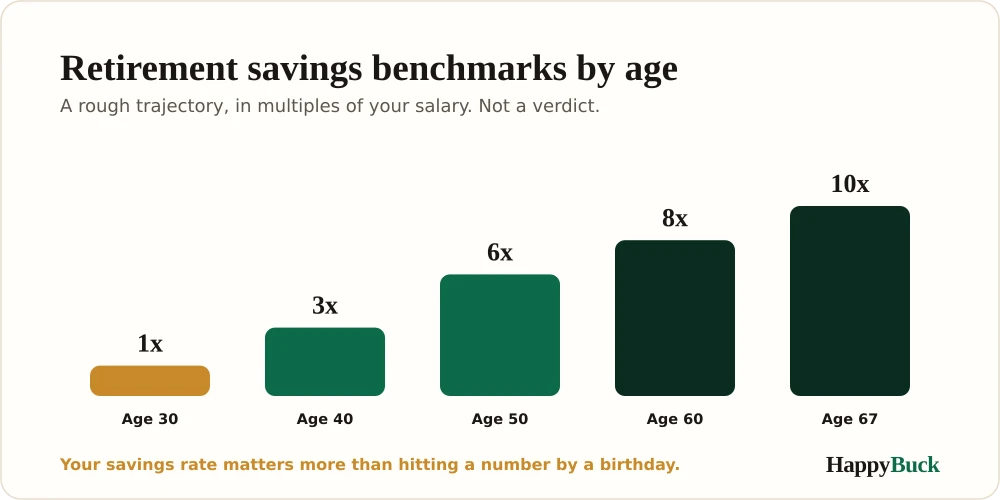
How much should you have saved by age? The common benchmarks suggest roughly one times your salary by 30, three times by 40, six times by 50, and eight times by 60, aimed mostly at retirement, plus a three-to-six-month emergency fund in cash along the way. Those are useful targets, but they are rough guides, not rules. What actually determines your future is your savings rate and consistency, not whether you hit a number by a birthday.
Two different things get lumped into “savings by age,” so it helps to separate them: your cash savings (your emergency fund and short-term goals) and your retirement savings (401k, IRA, and other long-term investments). The benchmarks below are mostly about retirement, but both matter.
Retirement savings benchmarks by age
These multiples-of-salary targets are the most widely cited guideposts for retirement:
| Age | Suggested retirement savings |
|---|---|
| 30 | About 1x your annual salary |
| 40 | About 3x your annual salary |
| 50 | About 6x your annual salary |
| 60 | About 8x your annual salary |
| 67 | About 10x your annual salary |
Read these as a trajectory, not a verdict. They assume you keep working and saving through retirement age, and they flex a lot based on when you plan to retire and how you want to live.
What people actually have saved
Here is the reassuring reality: almost nobody is hitting those benchmarks on schedule. Surveys consistently find that median cash savings sit in the low thousands of dollars for younger adults and rise only modestly with age, and that retirement balances, while larger, fall short of the “ideal” multiples for most age groups. If you feel behind, you have plenty of company. The point of the benchmarks is direction, not shame.
The number that matters: your savings rate
Chasing an age-based total can be discouraging and is not that useful anyway, because it ignores your income, your costs, and your goals. A far better target is a savings rate: the percentage of your income you consistently save. Aiming to save around 15 percent of your income toward retirement, plus building your emergency fund, does more for your future than obsessing over whether you have “1x by 30.” A steady rate compounds. A one-time snapshot does not.
How to catch up if you are behind
- Raise your rate gradually. Bump your savings by one percent of income every few months. You will barely feel it, and it adds up fast.
- Automate everything. Use pay yourself first so saving happens before you can spend.
- Bank your raises. Send half of every raise straight to savings before your lifestyle absorbs it.
- Use catch-up contributions. Once you turn 50, retirement accounts let you contribute extra each year. Use it if you can.
- Fix the foundation first. If you have no cushion, build a starter emergency fund before you pour everything into retirement.
My real advice on these benchmarks: ignore them. Comparing yourself to other people is a losing game, whether it is their savings, their car, their clothes, or their vacations. I know people who do it constantly, and they are never satisfied, because there is always someone further ahead. Social media has made it ten times worse. The only comparison that helps is you against your own situation a year ago. Focus on your own stuff, run your own race, and let everyone else run theirs.
I combed through Reddit and a few other places to see what people actually had saved at different ages, and the best response I found said it all. In a r/AskMenOver30 thread asking exactly this question, one person replied, “I don’t like this game.” And that is the whole point. The moment you start searching for where everyone else is at, you are usually already worried you have too little, and reading a hundred strangers’ numbers only feeds that. So stop. It is not healthy and it will not help you one bit. Be you, do you, and stop worrying about people on the internet.
The bottom line
Benchmarks describe averages, and you are not an average. Someone with no debt in a low-cost city and someone with student loans in an expensive one should not be measured by the same yardstick. Use the numbers as a loose compass, then get specific: build your emergency fund, automate a savings rate you can sustain, and raise it over time. That beats any birthday target.
What to read next
- Start with the foundation: how much emergency fund you need.
- Keep your cash somewhere it earns: high-yield savings accounts.
- Build the habit that hits any benchmark: pay yourself first.
There is no magic number you are supposed to have by 30 or 40. There is only the rate you save and how long you keep it up. Pick a percentage, automate it, raise it when you can, and let time do the heavy lifting. For research on what households actually have, the Federal Reserve’s Survey of Consumer Finances is the authoritative source.
Frequently asked questions
How much should I have saved by 30?
A widely cited benchmark is to have roughly one times your annual salary saved for retirement by age 30, plus a three-to-six-month emergency fund in cash. That said, it is a rough guide, not a rule. Many people are behind it in their 20s because of student loans and lower early-career income, and still end up fine by catching up later.
How much should I have saved by 40?
The common benchmark is about three times your annual salary saved for retirement by 40, on top of a full emergency fund. If you are not there, focus on your savings rate going forward rather than the gap behind you. Consistently saving 15 percent of income does more than obsessing over a benchmark.
What is the average savings by age?
Averages are far below the benchmarks. Surveys generally find median cash savings in the low thousands for people under 35 and rising modestly with age, while retirement balances are higher but still short of the "ideal" multiples for most age groups. In other words, almost everyone feels behind, so do not let the benchmarks discourage you.
Is it too late to start saving in my 40s or 50s?
No. Starting later means saving a higher percentage and leaning on catch-up retirement contributions, but plenty of people build real security starting in their 40s or 50s. The worst move is deciding it is hopeless and saving nothing. The best time to start was years ago; the second best time is now.


