
Pay Yourself First: How Reverse Budgeting Works
Pay yourself first flips the math: save before you spend, not with whatever is left. Here is how reverse budgeting works, how much to save, and how to automate it.


Pay yourself first means putting money into savings or investments the moment your paycheck arrives, before you spend a cent on anything else. You treat saving like a bill you owe yourself, automate it, and then live on whatever is left. Also called reverse budgeting, it is the least fussy budgeting method there is: no line-item tracking, no envelopes, just save first and spend the rest.
After years of trying stricter systems, this is the one that finally stuck for me. Zero-based budgeting never clicked, and I did not have the patience to track every category. What worked was dead simple: cover my essentials, automate a set amount into savings the day I got paid, and stop worrying about the rest. Taking the decision out of my hands was the whole trick. If the money never landed in my checking account, I never missed it.
How pay yourself first flips the math
Most people budget in this order: income, minus expenses, equals savings. Savings is the leftover, and leftovers have a way of disappearing. Pay yourself first flips that around.
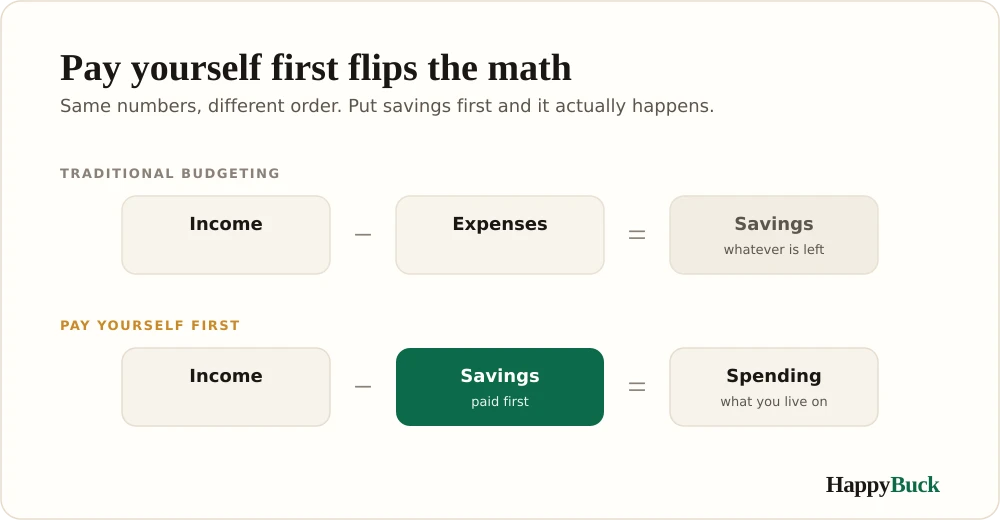
- Traditional budgeting: income − expenses = savings (whatever is left over)
- Pay yourself first: income − savings = spending (what you live on)
Same numbers, completely different result. When savings comes out first, it actually happens. When it comes last, it competes with every temptation of the month and usually loses.
How much should you pay yourself first?
The classic target is 20 percent of take-home pay, which is where the 80/20 budget gets its name: save 20 percent, live on 80. But the honest answer is that the right number depends on your fixed costs and your goals. The best percentage is the highest one you can keep up without blowing the rest of your budget.
| Your situation | A reasonable starting point |
|---|---|
| Just starting, or money is tight | 1% to 5%, then raise it slowly |
| Typical budget, some breathing room | 10% to 20% (the 80/20 rule) |
| Low fixed costs, aggressive saver | 20% to 30%+ |
The number matters far less than starting. A 1 percent habit you keep beats a 20 percent plan you abandon in a month.
How to set it up (so it runs itself)
Automation is the entire point. Willpower is unreliable, so you remove it from the equation.
- Pick your percentage. Start with a number you are confident you can sustain.
- Open a separate account. A high-yield savings account that is not your everyday checking, so the money is out of sight.
- Automate the transfer for payday. Schedule it for the day you get paid, or within a day, so the money moves before you can spend it.
- Split it if you can. Send some to retirement (like a 401k), some to savings, and let the rest flow to checking.
- Live on the rest, guilt-free. Once savings is handled, you do not need to track every coffee. That freedom is why people stick with this method.
The honest caveat
Pay yourself first only works if your essentials actually fit inside what is left after saving. If you save 20 percent and then cannot cover rent, you will just pull the money back out, which defeats the purpose. If that is you, start with a smaller percentage, or work on the income side first with our guide to breaking the paycheck-to-paycheck cycle. The other limit: because you are not tracking categories, this method will not catch overspending inside your 80 percent. If your problem is leaks rather than saving, an envelope system or zero-based budget may serve you better.
Where to go next
- Not sure this is your method? Compare it to the others: 50/30/20 vs zero-based vs envelope.
- Automating into an emergency fund is the best first destination for the money.
- Income that changes month to month? Pair this with the baseline approach in our irregular income guide.
Pay yourself first works because it stops relying on discipline and starts relying on a transfer you set up once. Decide on a percentage, automate it for payday, and let saving happen on autopilot while you get on with your life. For free worksheets to set your number, the Consumer Financial Protection Bureau has no-hype versions.
Frequently asked questions
What does pay yourself first mean?
Pay yourself first means moving money into savings or investments the moment you get paid, before you spend on anything else. It treats savings like a bill you owe yourself, rather than whatever happens to be left at the end of the month. It is also called reverse budgeting.
How much should I pay yourself first?
A common target is 20 percent of your take-home pay, the savings half of the 80/20 rule. But the right number depends on your fixed costs. If money is tight, start with whatever is sustainable, even 1 to 5 percent, and automate it. The habit matters more than the amount at first, and you can raise the percentage over time.
What is the 80/20 budget rule?
The 80/20 rule is the simplest version of pay yourself first. You save 20 percent of your take-home pay first, then live on the remaining 80 percent however you like, with no further tracking. It is popular because it takes almost no maintenance.
Who is pay yourself first best for?
It is best for people who hate detailed budgeting but still want to save consistently, and for anyone whose main goal is building savings or investments. It works less well if your essentials do not fit in what is left after saving, in which case you may need to start with a smaller percentage or free up income first.


