
High-Yield Savings Accounts: What They Are and How They Work
A high-yield savings account can pay 10x a regular savings account, with the same FDIC safety. Here is how they work, whether they are safe, and when one is worth it.


A high-yield savings account (HYSA) is a savings account that pays a much higher interest rate than a regular one, often around 10 times the national average, while keeping the same safety and easy access. You deposit money, it earns interest, and it stays FDIC-insured and available when you need it. If you are keeping cash in a big-bank savings account earning almost nothing, moving it to a HYSA is close to free money.
The difference is bigger than it sounds. Traditional savings accounts at big banks often pay a fraction of a percent, while high-yield accounts have paid 4 percent or more in recent years. On a $10,000 emergency fund, that is the difference between a few dollars a year and a few hundred, for doing nothing different.
How high-yield savings accounts work
A HYSA works exactly like any savings account. You deposit money, the bank pays you interest, and you can withdraw or transfer it when you need it. The interest is expressed as an APY (annual percentage yield), which folds in how often the interest compounds, so it is the number to compare between accounts.
The reason the rate is so much higher usually comes down to overhead. Most high-yield accounts are offered by online banks, which do not run expensive branch networks, so they pass those savings back to you as a higher APY. That is also why the trade-off is usually “no physical branch” rather than “more risk.”
HYSA vs a regular savings account
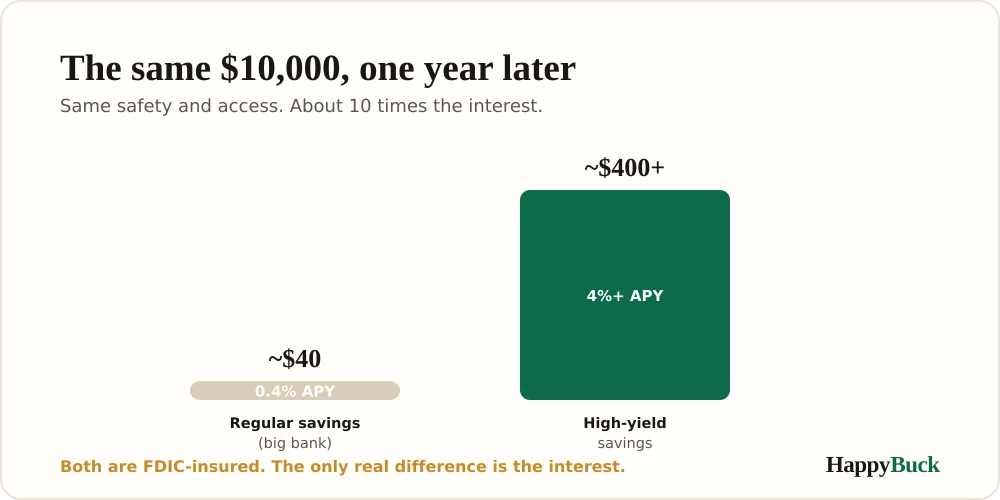
| Regular savings (big bank) | High-yield savings | |
|---|---|---|
| Typical APY | Around 0.4% or less | Around 4% or more |
| Interest on $10,000/year | A few dollars | A few hundred dollars |
| FDIC-insured | Yes | Yes |
| Access | Branch and online | Usually online only |
| Best for | Convenience of a branch | Emergency fund and short-term savings |
Same safety, same basic function, very different interest. For most people, the only reason to keep a big-bank savings account is branch convenience, and even then, your savings can live in a HYSA while your checking stays where it is.
Are they safe?
Yes, as long as the bank is FDIC-insured (or the credit union is NCUA-insured). That insurance covers up to $250,000 per depositor, per bank, and it is the same protection your regular bank carries. Your money is not invested, so unlike stocks, it cannot drop in value. The only real variable is the interest rate itself, which moves up and down with the broader rate environment. You are never at risk of losing your principal.
Is a high-yield savings account worth it?
For the right money, absolutely. A HYSA is the ideal home for:
- Your emergency fund, which needs to be safe and reachable.
- Short- and medium-term savings goals, like a car, a wedding, or a house down payment in the next year or two.
- Sinking funds for known upcoming costs.
Where a HYSA is not the answer is long-term wealth building. Over decades, savings-account interest tends to just keep pace with inflation, so money you will not touch for 10-plus years generally belongs in investments, not a savings account. Use a HYSA for safety and access, and invest for growth.
How to open one
It takes about ten minutes online. Compare a few accounts on APY first, then check the fine print: minimum balance requirements, any monthly fees (good ones have none), and transfer limits. Then link your existing checking account, make a first transfer, and set up an automatic recurring transfer so your savings grows on autopilot. We keep this deliberately non-promotional and do not push specific banks, so shop the current rates yourself.
Here’s the reality: I was late to this one. I kept my savings at TD Bank earning basically pennies for way too long before I finally moved it to a high-yield account at Capital One. Way too late, but I did it, and now the interest is meaningful. The money is just as safe and just as accessible, it just earns something now instead of sitting there doing nothing. If your savings are still at a big bank paying a rounding error, this is the easiest upgrade in personal finance.
What to read next
- This is the natural home for your emergency fund.
- Automate transfers into it with pay yourself first.
- Wondering if you are on track? See how much you should have saved by age.
A high-yield savings account is one of the rare no-brainers in personal finance: the same safety and access as a regular account, for many times the interest. If your cash is sitting somewhere earning nothing, move it. For the official rundown on how savings accounts and FDIC insurance work, the FDIC is the authoritative source.
Frequently asked questions
What is a high-yield savings account?
A high-yield savings account (HYSA) is a savings account that pays a much higher interest rate than a traditional savings account, often 10 times the national average or more. They are usually offered by online banks, which have lower overhead than branch banks and pass the savings on as a higher APY. They work like any savings account and are FDIC-insured.
Are high-yield savings accounts safe?
Yes. As long as the account is with an FDIC-insured bank (or NCUA-insured credit union), your money is protected up to \$250,000 per depositor, per bank. Your cash is not invested, so it cannot lose value the way stocks can. The main catch is that the interest rate is variable and can change over time.
Is a high-yield savings account worth it?
For money you want safe and accessible, like an emergency fund or short-term savings, yes. You earn meaningfully more interest for the same safety and roughly the same convenience as a regular savings account. For long-term goals like retirement, though, investing usually beats a HYSA because savings-account interest rarely outpaces inflation over decades.
What is the catch with a high-yield savings account?
There is no real catch, just a few things to know. The rate is variable and can drop, most are online-only so there is no branch, and some have transfer limits or minimum balances. It is also not a growth vehicle for long-term money. For a safe place to keep cash you might need, though, the downsides are minor.


