
Money-Saving Challenges That Actually Work (No-Spend, 52-Week, and More)
A good savings challenge turns saving into a game with a finish line. Here is how the no-spend, 52-week, and 100-envelope challenges work and how to pick the right one.


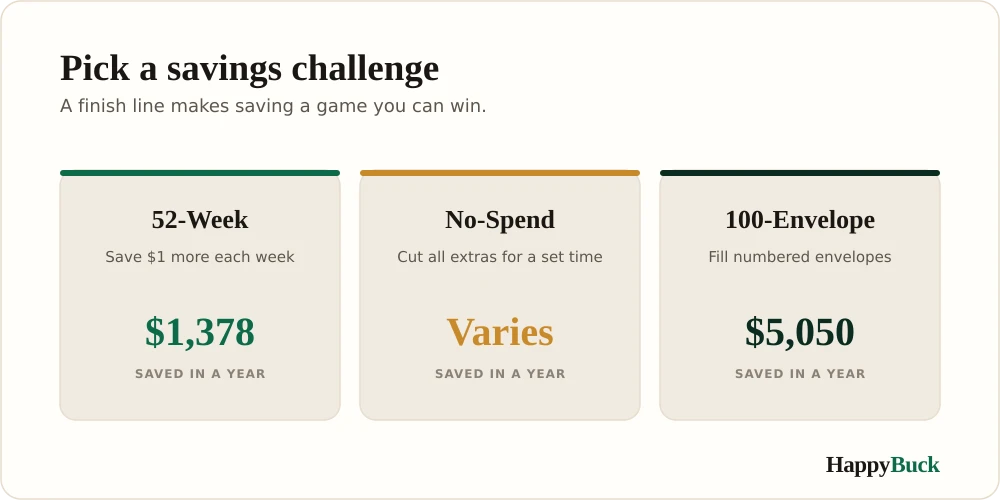
A money-saving challenge turns saving into a game with a finish line, which is exactly why they work when a vague goal to “save more” does not. The most popular ones are the no-spend challenge (cut all extras for a set period), the 52-week challenge (save a rising amount each week to reach $1,378), and the 100-envelope challenge (fill numbered envelopes to save $5,050). Any of them can jump-start your savings. The trick is treating the challenge as a launchpad for a lasting habit, not a one-time stunt.
Challenges are effective because they solve the hardest part of saving: starting, and keeping momentum. A clear rule, a visible tracker, and an end date give you the structure that willpower alone does not.
The most popular challenges, compared
| Challenge | How it works | What you save |
|---|---|---|
| 52-week challenge | Save $1 in week 1, $2 in week 2, up to $52 in week 52 | $1,378 in a year |
| No-spend challenge | Cut all non-essentials for a week or a month; bank the difference | Varies (often a few hundred a month) |
| 100-envelope challenge | Number 100 envelopes; each day fill a random one with that dollar amount | $5,050 in about 3 months |
| Pantry challenge | Eat down what you already have before buying more groceries | A week or two of grocery spend |
The 52-week challenge
The classic. Save $1 the first week and add a dollar each week after, so week 10 is $10 and week 52 is $52. You finish the year with $1,378, which is nearly a full starter emergency fund. The one snag is that the biggest weeks land near the holidays, when money is tight. Two easy fixes: run it in reverse (start at $52 and count down so the hard weeks are in January), or just save a flat $26.50 every week for the same total with no ramp.
The no-spend challenge
Pick a window, a weekend, a week, or a whole month, and spend only on true necessities. Bills and groceries, yes. Takeout, new clothes, and impulse buys, no. Move every dollar you would have spent into savings. Beyond the cash, a no-spend stretch is a great way to notice how much of your spending is autopilot. If a full month feels extreme, start with no-spend days a few times a week, or limit it to one category like dining out.
The 100-envelope challenge
Number 100 envelopes 1 to 100. Each day, pull one at random and put that many dollars inside. Fill all 100 and you have $5,050 in a little over three months. It is aggressive, and the big-number days can sting, but the visual progress is motivating. A gentler version: use smaller denominations, or stretch it over a longer period.
I will be honest: I have never done a strict no-spend month, and I am a little skeptical of them. To me they can feel like a crash diet, where you go to one extreme for a few weeks and then snap right back to your old habits the moment it ends. The same way real fitness comes from small, sustainable changes rather than a punishing 30-day cleanse, I think real saving comes from a few small tweaks and new habits that sit alongside your old ones, not from blowing everything up at once. If a challenge is what gets you moving, great. Just have a plan for day 31, because that is where the actual results live.
The honest part
A challenge is a sprint, and you cannot sprint forever. The people who actually get ahead are the ones who use the momentum from a challenge to set up something permanent. So when your challenge ends, capture the win: take the amount you proved you could save and turn it into an automatic transfer with pay yourself first. The challenge shows you what is possible. Automation makes it stick.
Where to go next
- Give your challenge savings a destination: a high-yield savings account.
- Turn the momentum into a habit with pay yourself first.
- Aiming the money at a goal? Start with your emergency fund.
The best money-saving challenge is the one that sounds fun rather than miserable, because you will actually finish it. Pick one, grab a tracker, and give yourself a finish line. Then, when you cross it, make the habit automatic so the savings keep going without the willpower.
Frequently asked questions
How does the 52-week money challenge work?
You save an increasing amount each week for a year: \$1 in week one, \$2 in week two, and so on up to \$52 in week 52. That adds up to \$1,378. If the higher amounts around the holidays are tough, you can flip it (save \$52 first and count down) or save a flat \$26.50 a week for the same total.
What is a no-spend challenge?
A no-spend challenge is a set period, often a week or a month, where you cut all non-essential spending: no takeout, no impulse buys, no extras. You still pay bills and buy necessities. Every dollar you would have spent gets moved to savings. It both builds savings and helps break spending habits.
Do money-saving challenges actually work?
They work well for people who are motivated by a clear goal and a finish line. The structure and momentum make saving feel like a game you can win, which helps you start. The catch is that a challenge is a sprint, not a system, so the real win is turning what worked into an automatic habit afterward.
Which money-saving challenge is best for beginners?
The 52-week challenge is the gentlest start because week one asks for just \$1. A one-week no-spend challenge is a good low-commitment way to reset spending habits. Pick whichever feels fun rather than punishing, since the one you finish beats the one that sounds impressive.


