Passive Income: What Is Real and What Is a Myth
Almost all "passive income" is neither passive nor income, at least not at first. Here is the honest breakdown of what actually works, what is a scam, and why I can spot the difference.


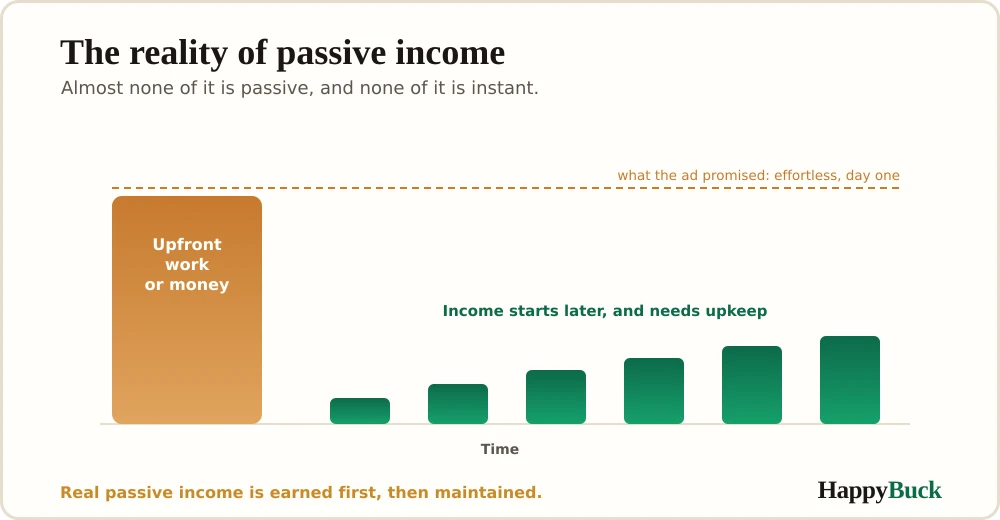
Here is the honest truth about passive income: almost none of it is actually passive, and almost none of it is income until after a lot of active work or real money goes in first. Genuinely passive income exists, dividends, rent, royalties, but every real version required significant effort, capital, or both to build, and then upkeep to maintain. The version sold in ads, real money for no skill, no work, and no money down, is a myth, and usually a marketing funnel dressed up as an opportunity. This guide separates the two so you do not waste time or cash on the fantasy.
I can spot the difference quickly, because I spent a decade writing the exact kind of marketing that sells these dreams. When you have built the funnels, you recognize the machinery instantly.
Why “passive income” is oversold
The phrase does a lot of dishonest work. It blends two very different things:
- Real passive income: money that flows with little ongoing effort, after you have put in serious upfront work or capital.
- The fantasy: meaningful money for essentially nothing, starting now, with no skill or investment.
The first is real and worth building. The second is what gets sold in ads, and it does not exist. Almost everything marketed as effortless passive income is either active work in disguise or a pitch designed to sell you a course, a program, or a click.
What actually works (with the real cost)
These are legitimate, but notice the upfront price in money or effort every single one demands:
| “Passive” income | Real upfront cost | How passive, really |
|---|---|---|
| Dividends / interest | Money to invest | Genuinely passive once funded |
| Rental property | Large capital + management | Semi-passive; real work and risk |
| Digital products (courses, templates) | Heavy work to create and market | Passive only after big active effort |
| Content (blog, video, audience) | Months to years of work | Passive-ish later; brutal at first |
| Royalties (books, music, licensing) | Create the work, and the luck | Passive after the hard part |
The most genuinely passive option on the list is the least glamorous: investing money you already have so it earns dividends and interest. That is real passive income, and it requires the one thing the fantasy skips, actual money to start.
How to spot the funnel
Since I have written these campaigns, here are the tells that something is selling the dream rather than an income:
- It focuses on the earnings and the lifestyle, not the real work or risk.
- It requires you to pay upfront to “unlock,” “start,” or “learn” the method.
- The person’s money comes from teaching it, not doing it. Ask how they actually earn.
- It promises passive, now, with no skill or capital. That combination does not exist.
- Urgency and scarcity are cranked up. “Spots closing,” “price rising,” designed to stop you thinking.
None of this means every course or program is a scam. It means the pitch, not the promise, is where the truth shows. If the message is about the money you will make instead of the value you will create, keep your wallet closed.
The honest way to think about it
Chasing passive income is often a way to avoid the more reliable path: build a real skill or service that pays now, then take that money and put it into genuinely passive assets like investments. Active income first, passive income second, funded by the first. That order is boring, and it is the one that actually works. The people quietly earning real passive income mostly got there by building or buying something real, not by clicking an ad.
Where to go next
- Build income that pays now: how to start freelancing.
- The genuinely passive kind starts with saving: high-yield savings accounts.
- Set realistic expectations: how much a side hustle can make.
- The full guide to side hustles.
Passive income is real, but it is earned, either with upfront work, upfront money, or both, and then maintained. Anyone selling you the effortless version is selling the dream. Build something real first, fund true passive assets with the proceeds, and ignore the ads. For unbiased basics on income-producing investments, the SEC’s Investor.gov is a solid, sales-free resource.
Frequently asked questions
Is passive income real or a myth?
Both. Truly passive income exists, but almost all of it requires significant upfront work, money, or both before it pays, and even then it needs upkeep. Dividend investing, rental property, and royalties are real. The myth is the version sold in ads: meaningful money for no skill, no work, and no capital. That version is usually a marketing funnel, not an income stream.
What is the most realistic passive income?
The most realistic passive income comes from investing money you already have, dividends and interest from index funds or high-yield savings, because it genuinely requires little ongoing work once funded. Beyond that, most "passive" income like rentals, digital products, or content is passive only after a large amount of active work to build and maintain it.
Can you make passive income with no money?
With no money, passive income requires heavy upfront work instead: building an audience, creating digital products, or producing content that earns later. It is possible but slow, and it is active work first, not passive. Anyone promising real passive income with no money and no effort is selling something. The upfront cost is always paid in either capital or labor.
Why is most passive income advice a scam?
Because the money is often made selling the dream, not doing the thing. Many "passive income" courses and programs earn by convincing you to buy the course, join the program, or click affiliate links, not from the strategy they teach. The tell is a pitch focused on the lifestyle and the earnings rather than the real, unglamorous work and risk involved.