
Cash Stuffing: How the Cash Envelope Method Works
Cash stuffing splits your spending money into labeled envelopes so when one is empty, you stop. Here is how to do it, which categories to use, and the honest downsides.


Cash stuffing is a budgeting method where you divide your spending money into labeled envelopes of physical cash, one per category, and spend only what is in each envelope. When the grocery envelope is empty, you are done buying groceries for the month. It is the old-school envelope system, back in style thanks to TikTok, and it works for one simple reason: spending real cash feels different from tapping a card.
The whole point is friction. Swiping a card is frictionless and invisible, which is exactly why it is so easy to overspend. Handing over cash and watching an envelope get thinner makes the money feel real, so you naturally slow down. If overspending on the day-to-day stuff is your problem, cash stuffing is one of the most effective fixes there is.
Why cash stuffing works
It comes down to psychology. Cash is visible, finite, and a little painful to part with. You can see how much is left, you cannot spend money that is not in the envelope, and the act of physically handing it over registers in a way that a swipe does not. There is no overdraft, no “I will check the balance later,” and no surprise at the end of the month. The empty envelope is the budget telling you to stop, in the clearest possible terms.
How to start cash stuffing, step by step
- Build a budget first. Cash stuffing is a tool for following a budget, not a replacement for one. If you do not have one yet, start with the 50/30/20 rule or a zero-based budget.
- Pick the categories you will pay in cash. Only the variable, spendable ones (more on which below).
- Set an amount for each. Decide what you can spend in each category this month. That number is what goes in the envelope.
- Withdraw the cash and label your envelopes. One envelope per category, the amount written on the front.
- Spend only from the matching envelope. Groceries come out of the grocery envelope, gas out of the gas envelope, and so on.
- When an envelope is empty, stop. That is the entire discipline. Borrowing from another envelope just moves the problem, so try to let empty mean empty until next month.
Which expenses belong in envelopes (and which do not)
This is the step most people get wrong. Cash stuffing is for your variable, discretionary spending, the categories where it is easy to lose track. It is a bad fit for fixed bills, which you should keep on autopay so you never miss one.
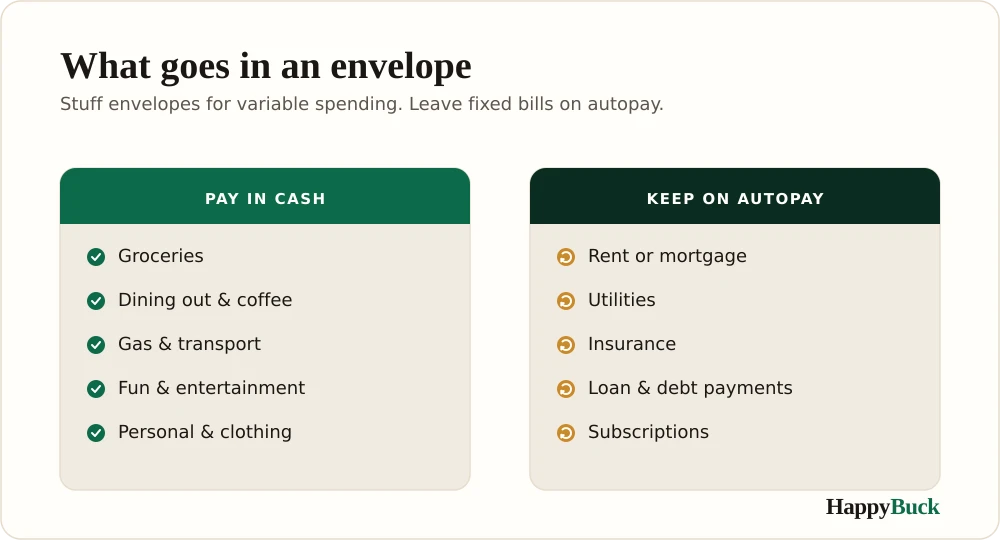
| Pay in cash (variable spending) | Keep on autopay (fixed bills) |
|---|---|
| Groceries | Rent or mortgage |
| Dining out and coffee | Utilities |
| Gas and transportation | Insurance |
| Fun and entertainment | Loan and debt payments |
| Personal and clothing | Subscriptions |
Trying to pay rent or your electric bill in cash just creates work and risk. Keep those automated. Save the envelopes for the spending that actually wanders.
Good cash envelope categories
- Groceries
- Dining out and coffee
- Gas and transportation
- Fun and entertainment
- Personal and clothing
- Household extras
- Hobbies
The honest downsides
Cash stuffing is genuinely useful, but the TikTok videos rarely mention the tradeoffs, and they are real:
- Security. A stack of cash at home or in a wallet can be lost or stolen, and there is no fraud protection or recourse if it disappears. A card you can cancel.
- It earns nothing. Money sitting in envelopes is money not earning interest. Cash you would otherwise keep in a high-yield savings account is giving up 4 percent or more a year, plus any card rewards.
- It does not build credit. If you are trying to build or repair credit, you need responsible card activity. An all-cash system does nothing for your score.
- It is inconvenient. Regular bank trips, and plenty of bills and purchases are online-only, where cash simply does not work.
- For some people, cash backfires. Research on spending habits has found that a portion of people actually spend more freely with cash, not less. If that is you, this method may work against you.
Not everyone clicks with cash
I never stuck with cash myself. Back in my bartending days I actually had plenty of it on hand from tips, but I found it easier to track my spending from the digital receipts in my bank account than to keep tabs on a wallet full of bills. Seeing every debit-card transaction listed out told me exactly where my money went. A stack of twenties never did.
I am far from alone. In a r/budget thread asking whether cash stuffing works for anyone, one person put it plainly: cash “definitely doesn’t work for me. It’s too hard to keep count of.” If they lose track, they have to recount the whole thing, whereas a card leaves a searchable record they can scroll through later. Another said the cash method did not work for them either, so they switched to a prepaid card loaded with a set amount. It gave them the same hard spending limit as an envelope, without the loose cash to manage. If that sounds like you, the good news is you can get the discipline of envelopes without the cash at all.
The digital version (same idea, fewer downsides)
If the psychology appeals but the cash does not, you can get most of the benefit digitally. Some banks let you split one account into labeled “buckets,” and budgeting apps recreate the envelope system on your phone. A zero-based budget in a spreadsheet does the same job: every dollar is assigned to a category before the month starts. You keep the discipline of “this is all I have for groceries” while your money stays insured and earning. Our Excel and Google Sheets guides walk through it.
Who cash stuffing is best for
It shines if you consistently overspend on the variable stuff, if cards feel too easy and you want spending to hurt a little, or if you are paying down debt and need hard limits. It is a poor fit if you are disciplined with cards already, if you are trying to build credit, or if most of your life runs on online payments. There is no prize for using cash if a digital envelope system keeps you just as honest.
Where to go next
- New to budgeting? Start with the guide to budgeting for beginners.
- Want to assign every dollar, cash or not? Read what zero-based budgeting is.
- Income that swings? Here is how to budget on an irregular income.
- Plan for the big irregular bills with sinking funds.
Cash stuffing is not magic, and it is not for everyone. But if your spending leaks out in small swipes you never notice, putting it back into envelopes can make the leaks impossible to ignore. Try it on a category or two, see if it changes how you spend, and keep what works. For free budgeting worksheets to build on, the Consumer Financial Protection Bureau has solid, no-hype versions.


