
How to Lower Your Monthly Bills (Negotiate and Cut Fixed Costs)
Your fixed monthly bills are where the biggest, easiest savings hide. Here is which bills you can negotiate, the script that works, and how one phone call pays off.


Your fixed monthly bills are where the biggest, laziest savings in your budget hide, because cutting one saves you money every single month without any ongoing effort. Many recurring bills are negotiable: internet, cell phone, cable, insurance, even some medical bills. The playbook is simple: know a competitor’s price, call and ask for the retention department, mention the better offer, and be willing to walk. One hour of phone calls can save hundreds of dollars a year that keep saving month after month.
This is the flip side of chasing coupons. A canceled subscription or a negotiated internet bill beats a dozen small sacrifices, because it repeats automatically. Do it once, save all year.
Which bills you can actually cut
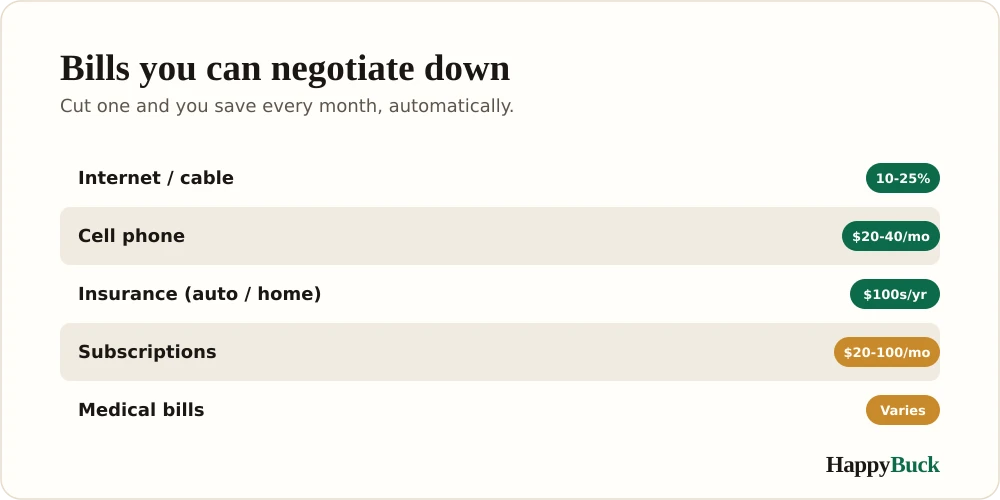
| Bill | How to lower it | Typical savings |
|---|---|---|
| Internet / cable | Call at promo expiration; cite a competitor; ask for retention | 10 to 25% |
| Cell phone | Switch to a cheaper carrier or plan; drop unused lines/insurance | Often $20 to $40/month |
| Insurance (auto/home/renters) | Shop quotes yearly; bundle; raise deductibles you can cover | Hundreds/year |
| Subscriptions | Audit and cancel what you do not use; downgrade tiers | $20 to $100+/month |
| Medical bills | Ask for an itemized bill, financial aid, or a payment plan | Varies, often large |
| Rent | Negotiate at renewal with a longer lease or comparable-unit data | Varies |
The script that works
Negotiating a bill is less confrontational than it sounds. The person on the phone deals with this all day and often has discounts ready. Here is the flow:
- Do five minutes of homework. Look up what a competitor charges for the same service right now.
- Call and ask for “retention” or “loyalty.” Front-line reps usually cannot give the real discounts. The retention team can.
- Be friendly and clear. “I have been a customer for X years and I would like to stay, but my bill has gone up and [competitor] is offering [price]. Can you match it or do better?”
- Let silence work. State your ask, then stop talking. Do not fill the pause.
- Ask the magic question. “Is that the best you can do?” It reliably surfaces one more discount.
- Be willing to walk. The credible ability to cancel is your leverage. Sometimes the best rate comes only after you start the cancellation.
Keep a quick note of what you were offered and when your promo expires, so you can run it again next year.
Start with a subscription audit
Before you even pick up the phone, do the fastest win there is: pull up your last statement and list every recurring charge. Almost everyone finds one or two they forgot about. Cancel what you do not use, downgrade what you barely do, and turn off auto-renew on the rest so the decision comes back to you next year instead of renewing on autopilot.
I did not start negotiating until later, after I bought a house, but once I did I could not believe what I had been overpaying. My Comcast TV and internet bill was ridiculous, and the part that really got me was paying a monthly “rent” on multiple cable boxes I barely used. I called and got it knocked down for a while before I eventually cut the cord entirely. The internet was overpriced too, but I was locked in until Fidium Fiber finally reached my area and gave me another option. Now I negotiate almost everything around the house. We have dogs, so we pay to spray the yard for ticks, and since every company does basically the same thing, I have swapped providers more than once just to get the price down. Same service either way, so why pay more?
The honest part
Two caveats. First, negotiating works best on competitive services with retention teams; you will not talk your water utility down. Second, do not confuse cutting a bill with cutting something you value. If a subscription genuinely makes you happy and fits your budget, keeping it is fine. The goal is to kill the bills you forgot you had and trim the ones you overpay for, not to strip your life bare.
Where to go next
- This is the fastest way to attack the big recurring costs we talk about in the saving guide.
- Trim the other flexible big category: how to save money on groceries.
- Send the savings somewhere useful: your emergency fund.
- Find the bills you forgot about by tracking your spending.
Lowering your bills is the highest hourly rate you will ever earn: an hour of calls for hundreds of dollars a year, repeating automatically. Block out an afternoon, work down your recurring charges one by one, and bank the difference. For help with medical bills specifically, the Consumer Financial Protection Bureau has free, no-hype guidance.
Frequently asked questions
Which monthly bills can you negotiate?
More than most people realize: internet, cable, cell phone, insurance (auto, home, renters), medical bills, gym memberships, and sometimes rent. Recurring service bills are the best targets, because providers have retention budgets and would rather cut your rate than lose you to a competitor.
How do you negotiate a lower bill?
Research a competitor's current price first, then call and politely ask for a better rate, mentioning the competing offer and your history as a customer. Ask for the retention or loyalty department, which has the authority to give real discounts. Be friendly but willing to walk, and always ask "is that the best you can do?"
How much can you save by negotiating bills?
Negotiating service bills commonly trims 5 to 25 percent off internet, cable, and phone plans, and shopping insurance can save hundreds a year. A single hour spent on a few calls can save hundreds or even over a thousand dollars a year, and those savings repeat every month.
When is the best time to negotiate a bill?
For internet and cable, call right when a promotional rate is about to expire, since that is when your bill jumps and providers expect churn. For insurance, shop at renewal. For rent, negotiate before you re-sign, ideally when you can offer a longer lease or point to comparable units nearby.


