
How to Track Your Spending (and Actually Stick With It)
The trick to tracking spending is not the app, it is friction. Pick the easiest method you will keep, run a 30-day audit, then go light-touch. Here is how.


To track your spending, pick one low-effort method you will actually keep using, a budgeting app, a spreadsheet, or a weekly review of your bank statement, and log every purchase including cash. Do it intensively for one month to see where your money really goes, then settle into a lighter routine of a quick weekly check-in. The method matters far less than whether you stick with it, so choose the simplest one you will not abandon.
The first time I tracked mine, it was a plain spreadsheet, and it paid for itself immediately. I dumped a month of expenses into it and the thing that jumped out was not rent or gas. It was subscriptions I had forgotten I was paying for. Just from seeing it laid out, I found over $100 a month I could take back. I did not keep logging every coffee forever, though. Once I knew where the leaks were, I plugged them and switched to just scrolling my bank app once a week. That is the part most guides skip: you track hard for a little while, not forever.
Why tracking usually fails (and how to fix it)
Tracking does not fail because you picked the wrong app. It fails because the system had too much friction, so you quit after two weeks. The fix is to make it as easy as humanly possible. A method you will keep up with beats a “better” one you abandon. Match the method to your personality, not to what a finance influencer swears by.
The main ways to track spending
| Method | Effort | Best for |
|---|---|---|
| Budgeting app with bank sync | Low once set up | People who want it automatic |
| Spreadsheet | Medium | People who like control and detail |
| Pen and paper or a notes app | Medium | People who want spending to feel deliberate |
| Weekly bank statement review | Low | Minimalists who just want the big picture |
There is no best method in the abstract. An app that auto-categorizes is the least work, a spreadsheet gives you the most control, and pen and paper makes every purchase feel deliberate, which is the point for some people. Pick one and start today.
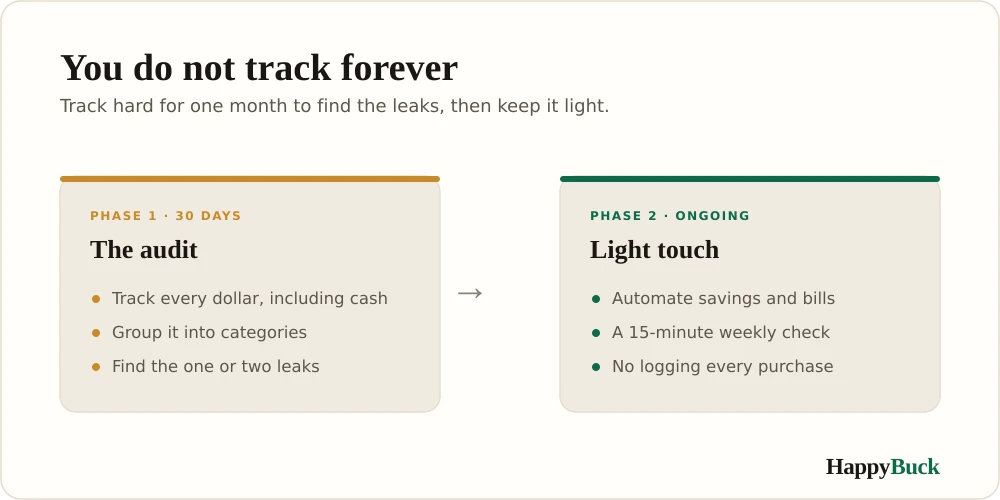
The 30-day audit: track hard, once
Here is the reframe that makes this bearable: you do not have to log every purchase for the rest of your life. Most of the value comes from one focused month.
- Track everything for 30 days. Every purchase, including cash, no matter how small.
- Group it into categories at the end: housing, food, transportation, subscriptions, fun, and so on.
- Find the leaks. Almost everyone has one or two categories that are far bigger than they guessed. That is the payoff.
- Fix what you found, then decide how lightly you can track from here.
Then go light-touch
Once the audit has done its job, you do not need the same intensity. Automate your savings with pay yourself first, put your fixed bills on autopay, and keep only a fifteen-minute weekly check-in to glance at what came in and what went out. Tracking becomes a quick habit instead of a second job, which is exactly why it sticks.
What a system you will actually keep looks like
The best setup is whatever is so frictionless you never skip it. I like how one person in a r/budget thread on the simplest way to track described their routine: every morning with their coffee, they spend about 30 seconds adding yesterday’s purchases to a spreadsheet. They pay all their bills on the first, set aside savings, buy anything they will need over the next month, and whatever is left is their spending money. The sheet subtracts each new purchase automatically, so they always see exactly how much they have left to spend.
That is the whole idea in a nutshell. Pay the important things first, then track the rest in a way so quick you will actually do it every day. Thirty seconds and a coffee beats an elaborate system you abandon by February.
Do not forget cash
Cash is the sneakiest leak because it leaves no digital trail. If you use it, log it the moment it leaves your hand, or empty your receipts during the weekly review. If most of your spending is cash, a written log or the envelope method will track it better than any app.
The honest part
Tracking shows you the truth, but it does not change anything by itself. It is a mirror, not a plan. The point of seeing where your money goes is to then do something about it, redirect the leaks into savings or debt payoff. If you track for a month and change nothing, you have spent effort for a spreadsheet full of receipts. Pair tracking with a budgeting method so the insight actually turns into progress.
Where to go next
- Ready to build the plan behind the tracking? Compare the budgeting methods.
- Want the numbers to add themselves up? Use our Excel or Google Sheets templates.
- Tracking is step one of breaking the paycheck-to-paycheck cycle.
Tracking your spending is the single most revealing thing you can do with your money, and it does not have to be forever. Pick the easiest method, run one honest month, fix what you find, then keep it light. For free tracking worksheets, the Consumer Financial Protection Bureau has simple versions to start from.
Frequently asked questions
What is the easiest way to track your spending?
The easiest method for most people is a budgeting app that connects to your bank and categorizes transactions automatically, because it needs almost no manual work. If you prefer to stay hands-on, a simple spreadsheet or even a weekly review of your bank statement works just as well. The best method is whichever one you will actually keep using.
How do I track cash spending?
Cash is the easiest money to lose track of because it leaves no digital record. Log it the moment you spend it, either with a quick note on your phone or a receipt you empty out during your weekly review. If most of your spending is cash, a written log or the envelope method will serve you better than an app.
How often should I review my spending?
Once a week is the sweet spot. Pick a set day, spend about fifteen minutes going over what came in and what went out, and adjust for the week ahead. Weekly is frequent enough to catch a problem early but not so often that it becomes a chore you abandon.
Do you have to track every expense forever?
No. The most useful phase is a focused 30-day audit where you track everything to see where your money actually goes. After that, most people switch to a lighter system, automating savings and just glancing at spending weekly, rather than logging every purchase for the rest of their lives.


