Side Hustle Statistics 2026: How Many Americans Have One and What They Earn
The latest national data on side hustles: how many Americans have one, what they really earn (the average is misleading), why they do it, and how earnings break down by generation.

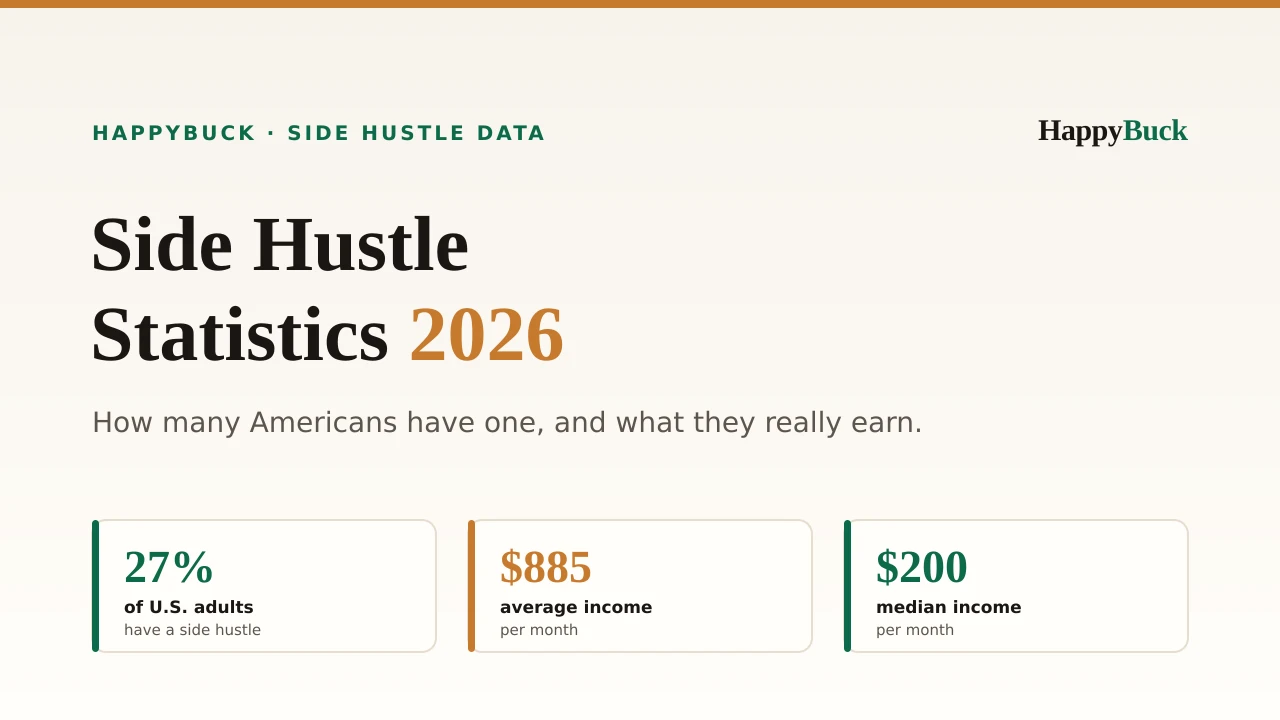
How many Americans have a side hustle, and what do they actually earn? Here’s the data-backed answer: about 27 percent of U.S. adults have a side hustle, roughly 90 million people, and they earn about $885 a month on average. But that average is misleading. The median side hustler earns just $200 a month, because a small number of high earners pull the average way up. Most people make a few hundred dollars on the side, not thousands.
The figures on this page come from the most recent national data, Bankrate’s Side Hustle Survey (fielded June 2025, 2,616 U.S. adults). Below are the key numbers, broken down by earnings, generation, and reason, with our honest read on what they mean. The charts are free to use with a link back (see how to cite this page).
Key side hustle statistics (2026)
- 27% of U.S. adults have a side hustle, about 90 million people (Bankrate, June 2025).
- That is down from 36% in 2024, the lowest share since 2017.
- Side hustlers earn $885 per month on average, but the median is just $200 per month.
- The 2024 figures were similar: $891 average, $250 median, so typical earnings slipped.
- By generation (average monthly): millennials $1,129, Gen Z $958, Gen X $751, boomers $561.
- By gender (average monthly): men $1,195, women $611.
- Why people side hustle: 41% for discretionary spending, 35% for regular living expenses, 28% to save, 20% to pay down debt.
The average side hustle income is misleading
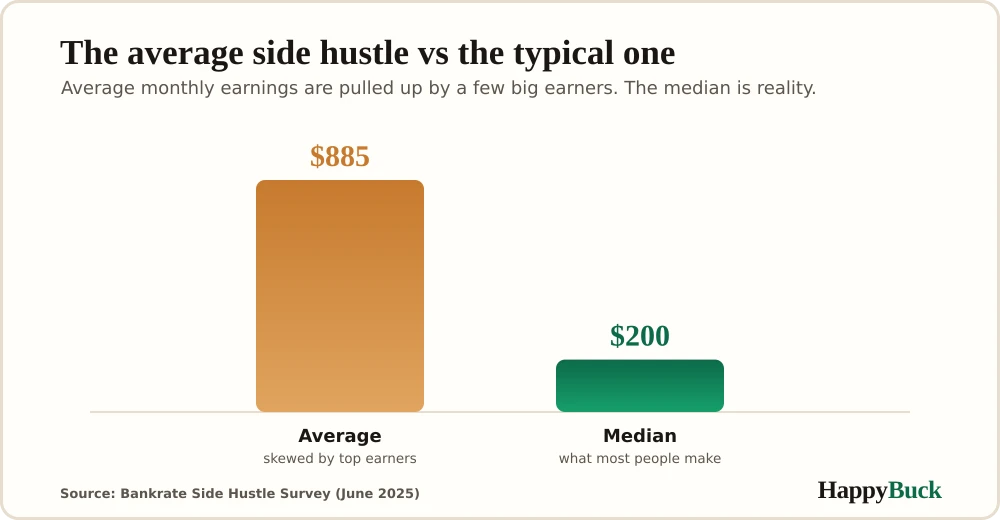
This is the single most important stat on the page, and the one most headlines get wrong. When you read that side hustlers earn “$885 a month,” that is the average, and averages get dragged upward by a handful of people running real businesses on the side. The median, the person right in the middle, earns $200 a month.
I have said for years that a realistic side hustle adds a few hundred dollars a month, not the five-figure numbers in the ads, and this is the data that backs it up. A couple hundred dollars a month is useful, it builds an emergency fund or pays down debt, but expecting the average is setting yourself up for disappointment. If you want the honest ranges by hustle type, we break them down in how much a side hustle can actually make.
How many Americans have a side hustle
About 27 percent of U.S. adults, roughly 90 million people, had a side hustle in 2025. That is a notable drop from 36 percent in 2024, and the lowest level since 2017. Bankrate credits a stronger job market and cooling inflation: when the main paycheck stretches further, fewer people feel they need a second one. In other words, the side-hustle boom of the early 2020s was driven partly by financial pressure, and some of that pressure has eased.
Side hustle earnings by generation
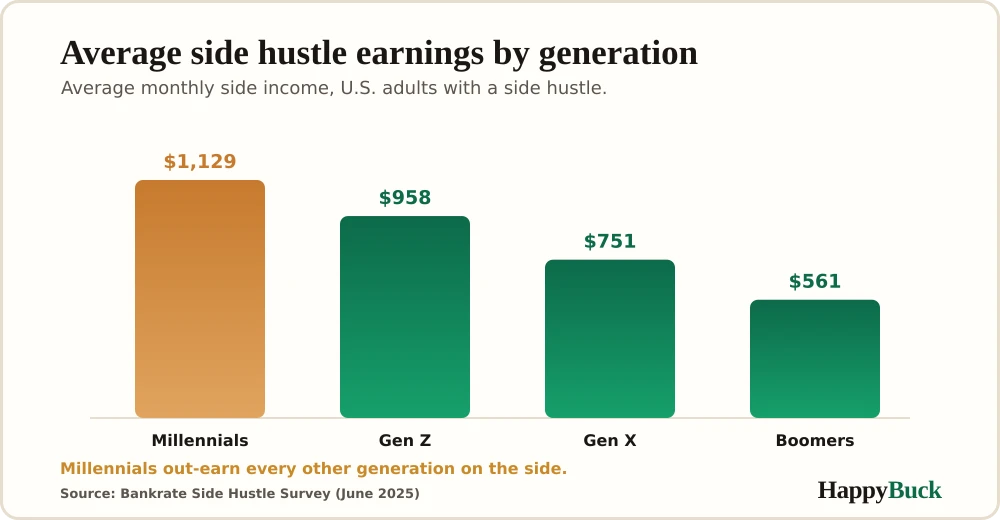
Millennials earn the most on the side, an average of $1,129 a month, followed by Gen Z at $958, Gen X at $751, and boomers at $561. There is also a wide gender gap: men average $1,195 a month versus $611 for women, a difference that tends to track the types of side work each group takes on and the hours available. Remember these are averages, so the same skew applies, the typical earner in every group makes less than the group average.
Why Americans have a side hustle
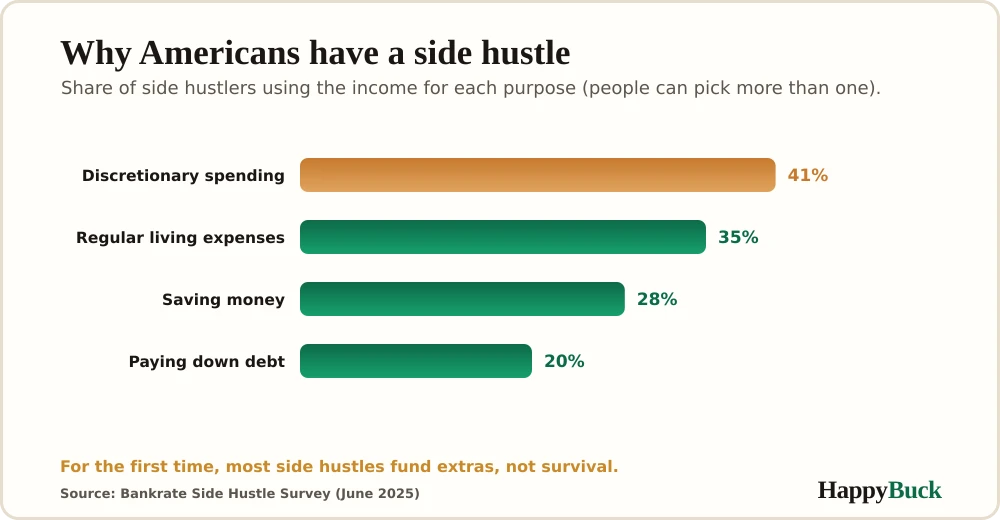
For the first time in recent years, the top reason for a side hustle is discretionary spending (41 percent), ahead of regular living expenses (35 percent), saving (28 percent), and paying down debt (20 percent). (People can pick more than one, so these do not add to 100.) Two years ago, covering necessities was the dominant motive. The shift toward “extras” is another sign that financial pressure has eased for many households, though a third of side hustlers still rely on the income just to get by.
The full data table
| Statistic | Figure | Source |
|---|---|---|
| U.S. adults with a side hustle | 27% (~90 million) | Bankrate, June 2025 |
| Share in 2024 | 36% | Bankrate |
| Average monthly earnings | $885 | Bankrate, June 2025 |
| Median monthly earnings | $200 | Bankrate, June 2025 |
| Average monthly earnings, 2024 | $891 | Bankrate |
| Median monthly earnings, 2024 | $250 | Bankrate |
| Millennials, average monthly | $1,129 | Bankrate, June 2025 |
| Gen Z, average monthly | $958 | Bankrate, June 2025 |
| Gen X, average monthly | $751 | Bankrate, June 2025 |
| Boomers, average monthly | $561 | Bankrate, June 2025 |
| Men, average monthly | $1,195 | Bankrate, June 2025 |
| Women, average monthly | $611 | Bankrate, June 2025 |
| Use it for discretionary spending | 41% | Bankrate, June 2025 |
| Use it for regular living expenses | 35% | Bankrate, June 2025 |
| Use it to save | 28% | Bankrate, June 2025 |
| Use it to pay down debt | 20% | Bankrate, June 2025 |
What the data says
Strip away the headlines and three honest takeaways stand out:
- A typical side hustle earns a few hundred dollars a month, not thousands. The $200 median is the number to plan around.
- Fewer people need one right now, and more of those who have one use it for extras, both signs of a bit less financial strain.
- What you earn depends far more on what you do than how many hours you put in. The generation and gender gaps mostly reflect the kind of work, not effort.
If those numbers make a side hustle sound worth it anyway, and for most people an extra few hundred a month is, start with the best side hustles ranked honestly, and do not forget to set aside money for taxes on whatever you earn. The full playbook is in our guide to side hustles.
Cite this page
Writers and researchers are welcome to cite these statistics and reuse the charts with a link back to this page. Suggested citation:
HappyBuck, “Side Hustle Statistics 2026,” https://happybuck.co/side-hustles/side-hustle-statistics/. Underlying data: Bankrate Side Hustle Survey (June 2025).
Sources
- Bankrate, Side Hustle Survey (fielded June 2 to 4, 2025; 2,616 U.S. adults).
- Reporting on the survey via CNBC.
Frequently asked questions
How many Americans have a side hustle?
About 27 percent of U.S. adults have a side hustle, according to the most recent Bankrate Side Hustle Survey (fielded June 2025), which works out to roughly 90 million people. That is down from 36 percent in 2024 and the lowest share since 2017, a drop Bankrate attributes to a stronger job market and cooling inflation.
How much does the average side hustle make?
Side hustlers earn about $885 a month on average, but that number is skewed by high earners. The median, what a typical side hustler actually makes, is just $200 a month. So while the average sounds impressive, most people earn a few hundred dollars a month, not thousands.
What is the average side hustle income by generation?
Based on the Bankrate survey, millennials earn the most on the side at about $1,129 a month on average, followed by Gen Z at $958, Gen X at $751, and boomers at $561. There is also a large gender gap: men average $1,195 a month versus $611 for women.
Why do people have side hustles?
For the first time in recent years, most side hustlers use the money for discretionary spending (41 percent) rather than necessities. Another 35 percent use it for regular living expenses, 28 percent to save, and 20 percent to pay down debt. The shift toward discretionary use suggests less financial pressure than in prior years.