How to Turn a Side Hustle Into a Full-Time Income
Some side hustles are meant to stay small. Others quietly become your career. Here is how to know the difference and make the leap safely, from someone whose side gig became his job.


Turning a side hustle into a full-time income is one of the most rewarding moves you can make, and one of the easiest to botch by leaping too soon. The safe version is simple: grow the hustle while you still have a paycheck until it reliably earns close to your take-home pay, build a cash runway of three to six months, account for the benefits and taxes your job used to cover, and only then make the switch, from strength, not desperation. Done that way, going full-time is a calculated step. Done on impulse after one good month, it is a gamble.
I know both the temptation and the payoff, because my side hustle became my career. Copywriting started as the thing I did nights and weekends while landscaping paid the bills. Over time it grew, steadily and then decisively, until it was clearly my real work. Here is how to make that transition without betting your stability on a hope.
First, decide if it should go full-time at all
Not every side hustle is meant to become a job, and that is fine. A hustle that adds $800 a month and stays fun is a genuine win. Before you scale it into a career, ask honestly:
- Do you actually want to do this 40-plus hours a week, or is part of its charm that it is small?
- Is the demand there to support a full income, or are you near its ceiling?
- Does it hold up without your day-job safety net behind it?
If the answers point to “keep it a side hustle,” that is a perfectly good outcome. This guide is for when the answers point to “this could be the whole thing.”
The milestones before you leap
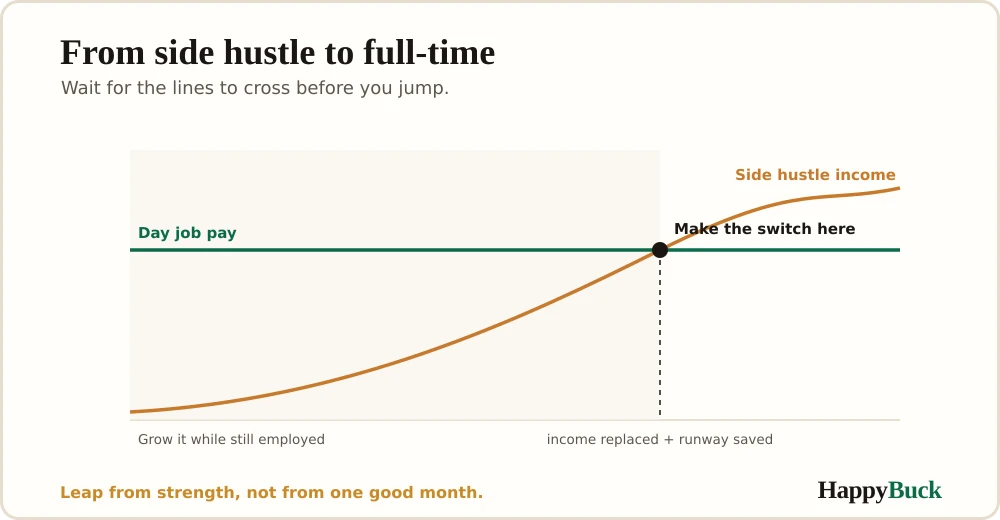
Make the switch when these line up, not before:
- Income replacement. Your side hustle reliably earns close to your take-home pay, for several months, not one lucky spike.
- A cash runway. A three-to-six-month emergency fund so a slow month does not sink you.
- Steady, repeat income. Enough recurring clients or demand that next month is reasonably predictable, not a fresh scramble.
- A benefits plan. You will now cover your own health insurance and retirement, so factor those real costs in.
When all four are true, you are leaping from strength. When they are not, you are gambling.
Grow it while you are still employed
The safest runway is the one you build with a paycheck still coming in. While employed, push the hustle toward full-time viability:
- Raise your rates and results, so you earn more per hour and can hit replacement income without needing infinite time. Charging for value is what makes the math work.
- Build recurring revenue, retainers, repeat customers, ongoing contracts, so income is predictable, not project-to-project.
- Bank the extra. Every dollar the hustle earns while you are still employed goes into your runway and your emergency fund, not your lifestyle.
This is the boring, powerful part. The bigger and steadier you make it before you quit, the smaller the leap becomes.
Account for what your job quietly gave you
A salary is not the only thing you are replacing. Before you go, price in:
- Health insurance, now fully on you.
- Retirement matching, which you will need to replace by investing on your own.
- Taxes, since you now owe income plus self-employment tax and pay it quarterly yourself.
- Income smoothing, because self-employed pay is lumpy, and your runway covers the dips.
Add these to your target number so “replacing my pay” means replacing what the job really provided, not just the salary line.
Then make the leap on purpose
When the income is steady, the runway is built, and the benefits are planned, make the switch deliberately. Give notice like a professional, keep your best clients close, and treat the first few months as the proving ground your preparation was built for. It will still feel like a leap, but a calculated one, with a net you built yourself.
Where to go next
- Build the cushion that makes it safe: emergency fund basics.
- Grow your rate and results: how to become a freelance writer.
- Keep taxes handled once it is your whole income: side hustle taxes.
- The full guide to side hustles.
Turning a side hustle into a career is absolutely possible. I am living proof. But the people who do it well are not the ones who quit in a burst of excitement. They are the ones who grew it quietly, stacked a runway, replaced what their job really gave them, and stepped across when the numbers already worked. Build it that way, and going full-time is not a gamble. It is a decision. For guidance on the business side of going independent, the SBA has free, practical resources.
Frequently asked questions
When should I turn my side hustle into a full-time job?
A safe rule is to wait until your side hustle reliably earns close to your current take-home pay for several months in a row, you have a cash runway of three to six months of expenses, and your income is steady rather than a one-time spike. Quitting the moment you have one good month is a gamble. Let the numbers prove themselves before you leap.
How much should my side hustle make before I quit my job?
Ideally your side hustle should consistently replace most or all of your take-home pay before you quit, or at least enough that your savings can cover the gap for several months. Also account for what your job provides beyond salary, like health insurance and retirement matching, since you will need to replace those too. Aim to leap from strength, not desperation.
How do I transition from a side hustle to full-time safely?
Grow the side hustle while still employed until it nears your salary, build a three-to-six-month emergency fund, line up enough clients or income to bridge the early months, and plan for taxes and benefits you will now handle yourself. Then make the switch when the numbers are steady, not on a single good month. The goal is a calculated step, not a leap of faith.
Is it risky to quit your job for a side hustle?
It is risky if you quit too early, on one good month, with no savings, or with unsteady income. It is much less risky if you wait until the hustle reliably replaces your pay, hold a solid cash cushion, and have accounted for benefits and taxes. Preparation is what turns a scary gamble into a reasonable, calculated move.