
How to Budget as a Couple (Joint, Separate, or Hybrid)
There is no single right way to budget as a couple. Here are the three common setups, how to split expenses fairly, and the one habit that matters more than the method.


There is no single right way to budget as a couple. The three common setups are keeping everything joint, keeping everything separate, or a hybrid of both, and shared costs get split either evenly or by income. Any of them can work beautifully. What actually matters is not which system you pick, but that you both agree on it, you are honest about money, and you adjust it when life changes. The method is the easy part. The conversation is the point.
I will be honest about my own setup: my wife and I sort of fell into ours. We each cover certain expenses, it was never some grand plan, and we basically never sit down for formal money “check-ins.” It works for us. But that is exactly the thing, what works for us might be a disaster for another couple. The examples below are all over the map, and every one of them is right for the people using it.
The three ways couples manage money
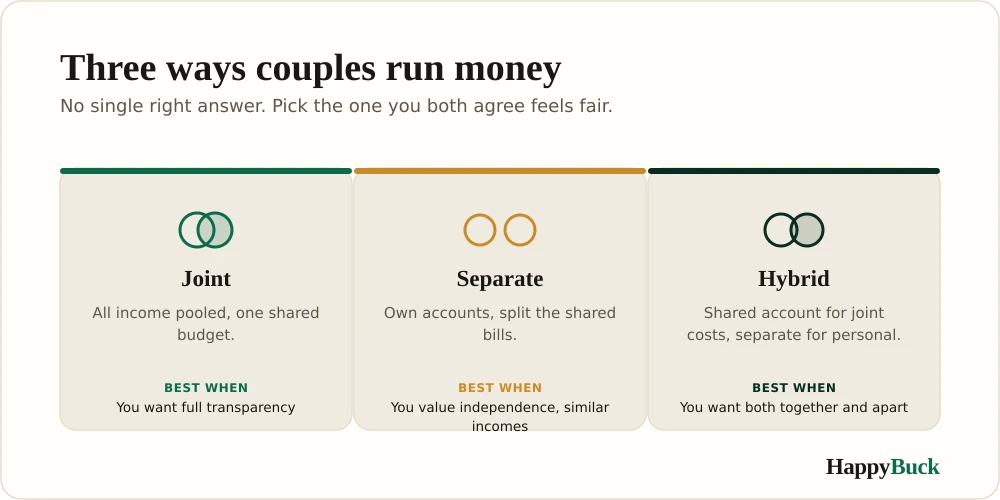
| Approach | How it works | Best when |
|---|---|---|
| Fully joint | All income pooled into shared accounts, one combined budget | You want maximum transparency and simplicity |
| Fully separate | Separate accounts, split the shared bills, keep your own money | You value independence and earn similar amounts |
| Hybrid | A joint account funds shared costs, separate accounts for personal spending | You want shared goals plus personal freedom |
Fully joint is the simplest and most transparent: every dollar is “ours,” so there are no secrets and nothing to reconcile. Fully separate keeps independence and privacy, with each person responsible for their own money and a plan for who pays which shared bill. Hybrid is the most popular for a reason: a shared account covers the joint stuff while each person keeps their own money for personal spending, so you get togetherness and autonomy at once.
How to split shared expenses
Once you know where the money lives, you decide how to divide the shared costs. Two fair options:
- Split it 50/50. Simple and clean, and it feels fair when your incomes are close. Rent, groceries, and utilities are just divided in half.
- Split it by income (proportional). When one person earns significantly more, an even split can quietly squeeze the lower earner. Instead, each person pays the same percentage of the shared bills as they earn of the household income.
The proportional math is quick. Add both incomes to get the household total. Work out each person’s share of it. Then each pays that share of the shared expenses. If together you bring in $8,000 a month and one of you earns $5,000 of it, that person covers about 62 percent of the shared bills and the other covers 38 percent. Same bills, split in a way that leaves you both with similar breathing room.
How real couples actually do it
This is where it gets clear that there is no template. In a thread on r/AskWomenOver30 about splitting finances with a partner, the same question produced completely different answers that all worked:
- One splits the big stuff 50/50, mortgage, car, insurance, groceries, and even divides utilities by trading bills of similar size (“I pay electricity and he pays internet”). They keep a joint credit card for shared purchases and pay it off 50/50 every week, while the rest of their money is their own. It works partly because they earn about the same.
- Another kept an exact running tally before marriage, settling up so nobody was ahead, then loosened way up after: “He pays for food, I pay the mortgage, he pays the trash bill, I pay the water bill.” Random purchases go to whoever grabs their card first. Not precise, but it evens out, and they make financial decisions together.
- A couple who got together in their late 30s runs a combination: separate bank and retirement accounts, joint ownership of the home with a split mortgage and utilities, a shared card for daily purchases that they divide in two each month, and fully separate spending on personal things like clothes.
Three couples, three systems, zero overlap. The common thread is not the mechanics. It is that each pair figured out what felt fair to them and agreed on it.
The one thing that matters regardless
You can skip the spreadsheets and the formal monthly meetings if that is not your style. What you cannot skip is being on the same page. That means talking openly about income, debt, and goals, and revisiting the arrangement when something big changes: a new job, a baby, a house, a jump or drop in income. A system you set up at one income can quietly turn unfair at another. You do not need a ritual, you need honesty and the willingness to adjust.
The honest caveat
No account structure fixes mismatched values or hidden debt. If one person is secretly carrying balances or you fundamentally disagree on saving versus spending, the setup is not the real issue, and the fix is a real conversation, not a new spreadsheet. Money is one of the top things couples fight about, and almost always the fight is about expectations and trust rather than the mechanics of who pays the water bill. Get honest first, then pick whatever system fits.
Where to go next
- Pick a budgeting method to run together: 50/30/20 vs zero-based vs envelope.
- Save toward shared goals a little at a time with sinking funds.
- Automate the saving so neither of you has to think about it, with pay yourself first.
- Build the shared emergency fund that protects you both.
The best way to budget as a couple is the one you both actually agree on and will stick to. Talk it through, pick joint, separate, or hybrid, split the shared costs in a way that feels fair, and revisit it when life shifts. For free budgeting worksheets you can fill in together, the Consumer Financial Protection Bureau has simple ones.
Frequently asked questions
How should couples split finances?
There is no single correct way. The three common setups are fully joint (all money pooled), fully separate (own accounts, split the shared bills), and hybrid (a joint account for shared costs plus separate personal accounts). Shared expenses are usually split either 50/50 when incomes are similar, or proportionally by income when they are not. The best choice is the one you both agree feels fair.
Should couples have joint or separate bank accounts?
Both work, and many couples use a mix. Joint accounts make shared bills and transparency simple, while separate accounts preserve independence and privacy over personal spending. A hybrid setup, one joint account for shared costs and separate accounts for personal money, gives you most of both. What matters is that you both understand and agree on the arrangement.
How do you split bills when one person makes more money?
When incomes are uneven, splitting everything 50/50 can leave the lower earner stretched. Many couples split shared expenses proportionally instead. Add up both incomes, work out each person's share of the total, and have each contribute that percentage of the shared bills. If one partner earns 60 percent of the household income, they cover 60 percent of the shared costs.
Do couples need to combine their finances?
No. Plenty of couples keep entirely separate finances and simply divide the shared bills, and it works well for them. Combining is about preference and trust, not a requirement. The non-negotiable part is open communication, so there are no money secrets and you are working toward the same goals.


