
How to Pay Off Debt on a Low Income (Without Losing Hope)
Paying off debt on a tight income is slow, not impossible. Here is a realistic plan: protect your minimums, free up small amounts, attack one debt, and get real help.


Paying off debt on a low income is slow, not impossible, and most advice ignores how hard it actually is. Here is the realistic version: protect the minimum payment on every debt so you avoid fees and credit damage, free up even small amounts of money, attack one debt at a time, and get free help when you need it. And be honest about the ceiling, because past a point, the fix is not cutting deeper, it is earning more. None of this is fast. All of it works if you keep going.
I do not say that lightly. My mom raised my sister and me on a teacher’s salary while quietly carrying serious debt, and she dug out of it through exactly this kind of slow, stubborn consistency. It scared me and it also showed me it can be done. If money is tight, this is the plan.
Step 1: Protect every minimum payment
When money is scarce, the single most important thing is to never miss a minimum payment. Missed payments trigger late fees, penalty interest rates, and credit damage, all of which make your debt harder to pay, which is the trap that keeps people stuck. Before you put a dollar toward extra payoff, make sure every minimum is covered. If you genuinely cannot cover one, skip to the “get help” step below and call before the due date.
Step 2: Free up small amounts (they count)
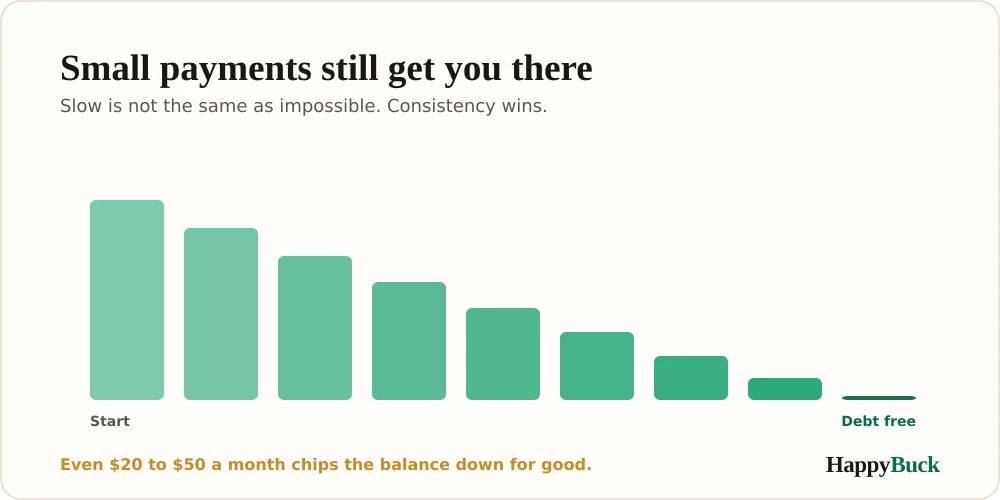
You do not need a big surplus to make progress. Even $20 or $50 a month, aimed at one debt, chips the balance down and builds momentum. Find it in the places that do not hurt your quality of life:
- Cancel forgotten subscriptions and negotiate your bills.
- Trim the flexible categories like groceries.
- Kill bank fees and overdraft charges, which are pure waste.
Step 3: Keep a tiny buffer, then attack one debt
Set aside a small $300 to $500 emergency fund first. It feels backwards to save while you owe, but without any cushion the next surprise goes right back on a credit card and erases your progress. With that buffer in place, pay minimums on everything and throw every extra dollar at one debt, either the smallest balance for a motivating win or the highest rate to save money. Then roll that payment to the next.
Step 4: Get free, legitimate help
You do not have to figure this out alone, and the good help is free:
- Call your creditors. Ask for a lower interest rate, a hardship plan, or a temporary lower payment. They would rather work with you than lose the money. It costs nothing to ask.
- Use nonprofit credit counseling. Agencies through the National Foundation for Credit Counseling offer free or low-cost advice and can set up a debt management plan that lowers your rates.
- Avoid for-profit “debt relief.” Companies that charge big fees and tell you to stop paying can wreck your credit and leave you worse off. On a tight budget, you cannot afford that risk.
Step 5: Be honest about income
Here is the part most guides skip. There is a floor to how much you can cut, and if your debt payments genuinely do not fit your income, no amount of frugality closes that gap. Past that point, the highest-leverage move is raising income, whether that is more hours, a better-paying job, or a side hustle. Cutting matters, but on a low income, earning a little more often moves the needle more than any spreadsheet. That is not a failure. It is just where the real math is.
Where to go next
- Pick your payoff order: snowball vs avalanche.
- Build the buffer that keeps you off the cards: emergency fund basics.
- Change the math on the income side: side hustles.
- The full plan to get out of debt.
Getting out of debt on a low income is a war of attrition, and attrition is winnable. Protect your minimums, free up what you can, attack one debt at a time, take the free help, and push on the income side where cutting runs out. It is slow, but slow and steady is exactly how my mom did it, and how you can too.
Frequently asked questions
How do I pay off debt when I barely have money?
Protect the minimum payment on every debt first to avoid fees and credit damage, then free up even small amounts, \$20 or \$50, and throw them at one debt at a time. Cut costs you will not miss, call creditors to ask for lower rates or hardship plans, and use free nonprofit credit counseling. Small consistent progress genuinely adds up.
What should I do first if I cannot afford my debt payments?
Call your creditors before you miss a payment, not after. Many have hardship programs, lower-payment options, or can temporarily reduce your interest. A nonprofit credit counselor can help you set up a debt management plan. Missing payments quietly is the worst option, because fees and credit damage make everything harder.
Is it possible to get out of debt on a low income?
Yes, though it takes longer and requires patience. The math is the same as for anyone: pay minimums, attack one debt at a time, and stop adding new debt. On a low income, the income side matters even more, so raising your earnings, even a little, often does more than any further cutting.
Should I save or pay off debt on a low income?
Build a tiny buffer first, even \$300 to \$500, so a small surprise does not force you deeper into debt, then focus on your highest-rate balances. Without any cushion, every emergency goes back on a credit card and undoes your progress. A small emergency fund is what makes debt payoff stick.


