
How to Save Money on a Low Income (When It Feels Impossible)
Saving on a low income is not about willpower, it is about tiny, automatic habits and honesty about the limits. Here is how to start, even when it feels impossible.


Saving money on a low income is hard, and most advice about it is useless because it assumes a bigger paycheck. Here is the realistic version: start absurdly small, automate it so it does not depend on willpower, cut the costs you will not actually miss, and be honest about when the real answer is earning more, not saving harder. A $10-a-paycheck habit that you keep beats a $500-a-month plan that collapses in week two.
The goal at the start is not a big number. It is proof to yourself that you can save at all, plus a small cushion so the next surprise does not wreck you or push you into debt.
Start with a habit, not an amount
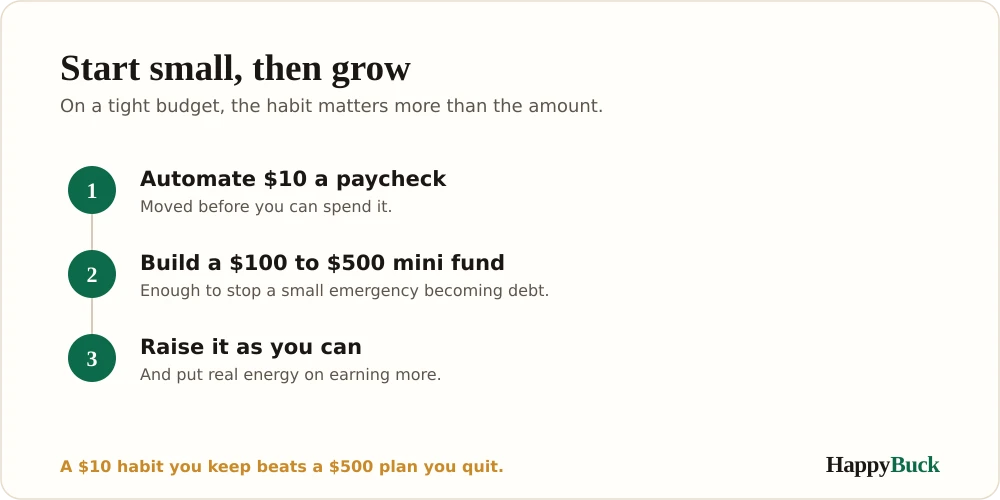
Pick a number so small it feels almost silly, like $10 or $20 a paycheck, and automate it into a separate savings account the day you get paid. If the money never lands in checking, you never miss it. That is pay yourself first scaled to a tight budget. Your first target is a mini emergency fund of $100 to $500, which is enough to cover a lot of real emergencies and to keep one flat tire from becoming a payday loan.
The amount will feel too small to matter. It is not. The habit is the point, and you can raise it later as things loosen up.
Cut the costs you will not miss
On a tight budget, protect the small things that keep you sane and go after the costs you would not even notice were gone:
- Bank fees. Overdraft and monthly maintenance fees are pure waste. Switch to a free checking account and turn off overdraft.
- Forgotten subscriptions. Pull your statement and cancel what you are not using. This is often the fastest money on a low income.
- High-interest debt. Interest is a bill you pay for past spending. Even small extra payments on your highest-rate balance free up money over time.
- The big flexible categories. Groceries and transportation have the most give. Meal planning and packing lunch genuinely add up.
Notice what is not on that list: your one small comfort. Keep it. Deprivation budgets fail.
Use every dollar the system offers
Saving on a low income is not only about cutting. Make sure you are collecting what you are owed:
- Assistance programs. SNAP, utility assistance, and local programs exist for exactly this. Using them while you get your footing is smart, not shameful.
- Tax credits. The Earned Income Tax Credit and others can mean a meaningful refund. Free filing help through the IRS VITA program makes sure you claim what you qualify for.
- Employer matches. If your job offers any 401k match, even a small contribution to capture it is free money.
When I was bartending, two things stand out. What worked was being honest about my situation. I had a chance to move in with a friend, but staying at my dad’s place, where he charged me less than renting would have cost, was clearly the smarter move. I gave up a little freedom, but it was the right call, and living cheap is what let me save anything at all. What did not work was micromanaging every small expense. I tried skimping on the little things, the breakfasts with friends, grabbing a few drinks out, and I quickly realized I was saving almost nothing while missing out on great memories. There is a fine line here. You still have to enjoy your life, even if that means spending an extra five or ten bucks. And believe me, there was a stretch when I barely had that to spare.
The honest part
There is a limit to frugality, and pretending otherwise is dishonest. If you have cut everything and your essentials still do not fit your income, the problem is not your discipline, it is the size of your paycheck. Past a point, the highest-leverage move is not another spreadsheet, it is earning more, whether that is more hours, a raise, a better-paying job, or a small side income. Save what you realistically can, and put your real energy on the income side. That is where the math actually changes.
Where to go next
- Build the cushion, one small deposit at a time: emergency fund basics.
- Automate the habit: pay yourself first.
- Trim the recurring stuff: how to lower your monthly bills.
- Change the math: side hustles and ways to earn more.
Saving on a low income is not about willpower or sacrifice. It is about a tiny automatic habit, cutting what you will not miss, claiming what you are owed, and being honest that income is the real lever. Start with $10. Keep it up. Raise it when you can. That is how it actually happens.
Frequently asked questions
How can I save money when I have a low income?
Start much smaller than the usual advice suggests. Automate a tiny amount, even \$10 a paycheck, into a separate savings account so it happens before you can spend it. Aim first for a mini emergency fund of \$100 to \$500. The amount matters less than the habit, and small consistent deposits genuinely add up.
How much should I save if I do not make much money?
Save whatever is sustainable, even if it is 1 to 5 percent of your income. A flexible split like 70/20/10 (more for needs) can be more realistic than 50/30/20 on a tight budget. The goal is a habit you can keep, not a percentage from a blog that assumes a bigger paycheck.
What should I cut first on a tight budget?
Start with costs that do not lower your quality of life: bank fees, forgotten subscriptions, and interest on high-rate debt. Then look at the big flexible categories, food and transportation. Avoid cutting the small things that keep you sane; the real savings are in the recurring stuff you will not miss.
Is it worth saving small amounts of money?
Yes. Saving \$10 or \$20 at a time does two things: it builds a cushion, and more importantly it builds the habit and the identity of someone who saves. That foundation is what lets you save more later when your income grows. Consistency beats size every time, especially early on.


